Everything About AI Overviews (AIO) in 10 Seconds:
- AI Overviews were rolled out in Germany, Austria, and Switzerland on March 26, 2025
- AI Overviews are shown primarily for informational search queries
- AI Overviews appear more frequently in searches with many zero-click searches
- Sources for AI Overviews mostly come from the top 10
- The frequency of AI Overviews differs from topic to topic
- AI Overviews reduce organic and paid click-through rates
- AI Overviews are constantly changing. Their appearance too.
It was a moment that changed search behavior forever:
When Google announced in May 2024 that it would roll out AI Overviews to all US users, the SEO world was in turmoil. The Search Generative Experience (SGE), previously tested in Search Labs, became a permanent part of Google Search – with profound effects on click behavior, content strategies and brand presence.
But how often do AI Overviews really appear? Which searches trigger them? And how can you ensure your company remains visible in them?
This article provides data-based answers and shows you how to strategically use Google AI Overviews for your brand.
-
 Last updated: 6. February 2026Google AI Overviews: What’s Changing for SEO & SEA in 2025
 -
 Last updated: 12. February 2026Large Language Model Optimization (LLMO) explained
 -
 Last updated: 12. February 2026Generative Engine Optimization (GEO) explained
 -
 Last updated: 10. February 2026Understanding Google AI Mode: Overview & Functions
 -
 Last updated: 6. February 2026LLMO, GEO & SEO Costs: Budgets + Distribution for AI Search
Video: Assessment of AI Overviews from March 26, 2025
In this video, I share my current thoughts and assessments on the introduction of AI Overviews:
What is an AI Overview?
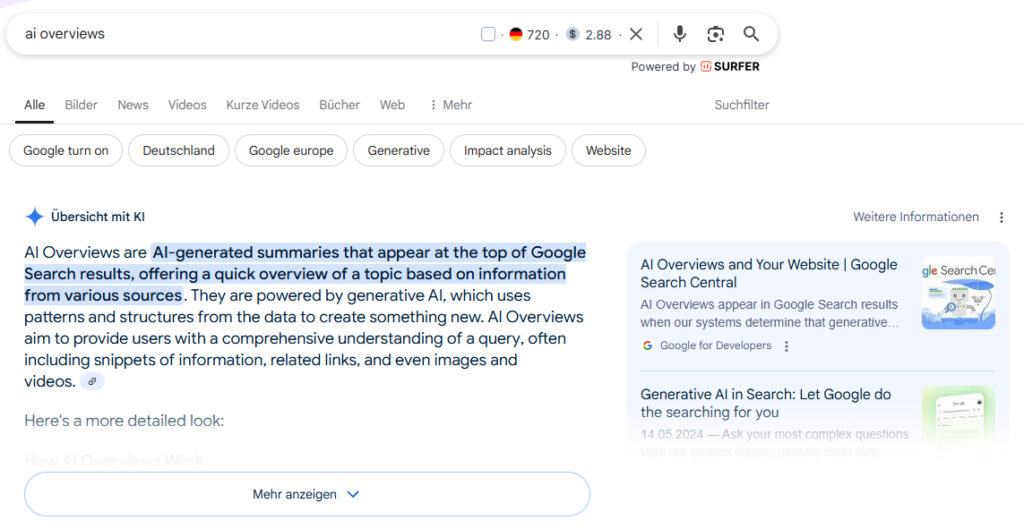
A so-called AI Overview – sometimes also referred to as an “AI Snapshot” – summarizes information from various sources to answer search queries as precisely and comprehensively as possible. The system transparently displays the sources used and links them directly. This creates a diverse overview that goes far beyond the informational value of a single search result. Additionally, visual elements such as products, videos, or images can be integrated to offer users even more practical value.
The Evolution of AI-Powered Search
Artificial intelligence has been an integral part of the Google ecosystem for over a decade. With the emergence of generative AI, Google began comprehensively integrating this technology into its products.
In the second half of 2023, Google launched a large-scale experiment called Search Generative Experience (SGE). This test phase investigated how generative AI could improve search.
On May 14, 2024, Google finally announced that SGE would be renamed AI Overviews (AIO) and made available to users outside the Labs. AI Overviews are based on the Google Gemini AI Language Model and are currently available almost everywhere.
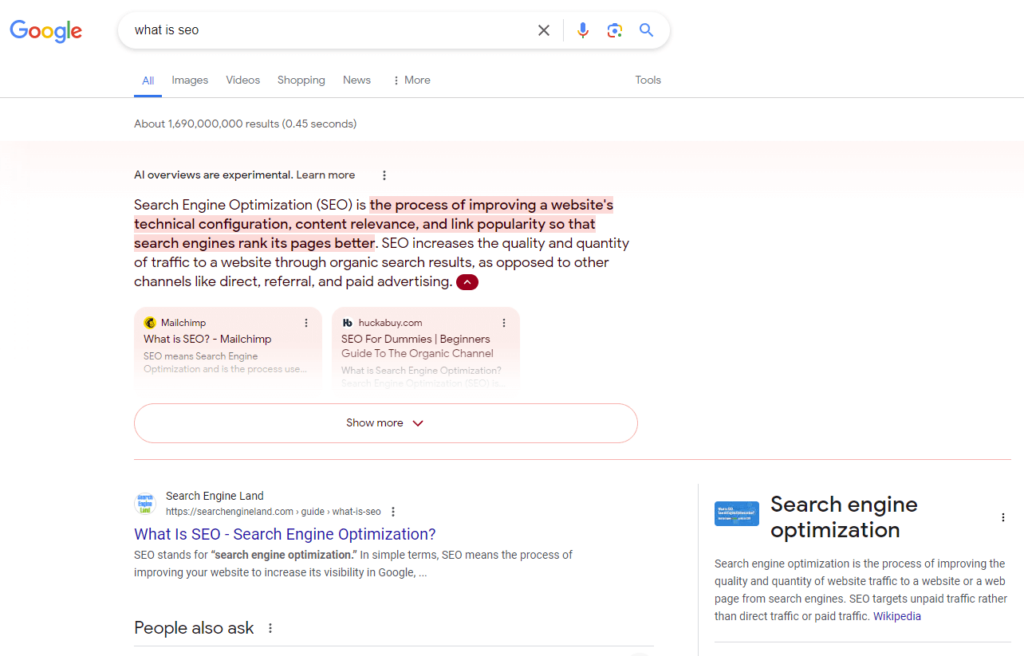
Search query “what is seo” (informational):
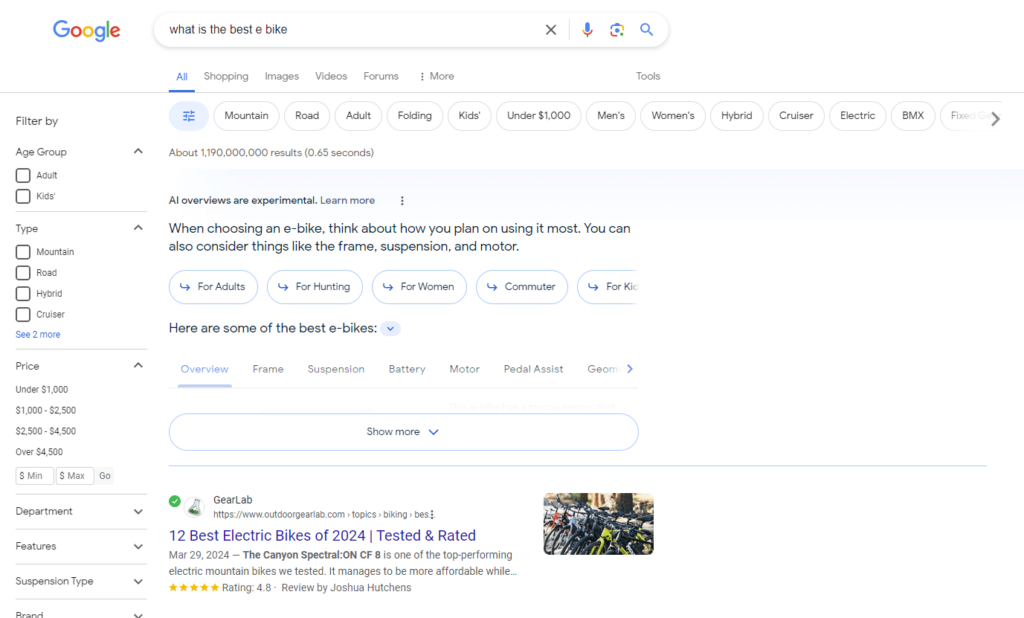
Search query “what is the best ebike” (product research)
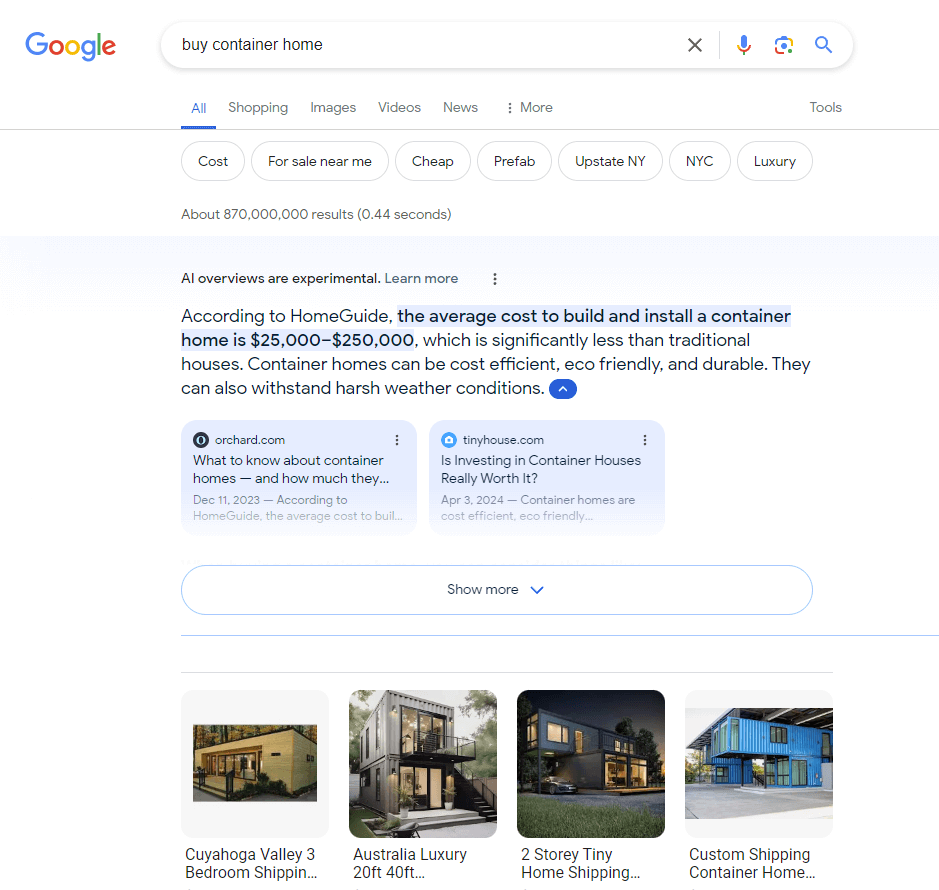
Search query “buy container home” (commercial)
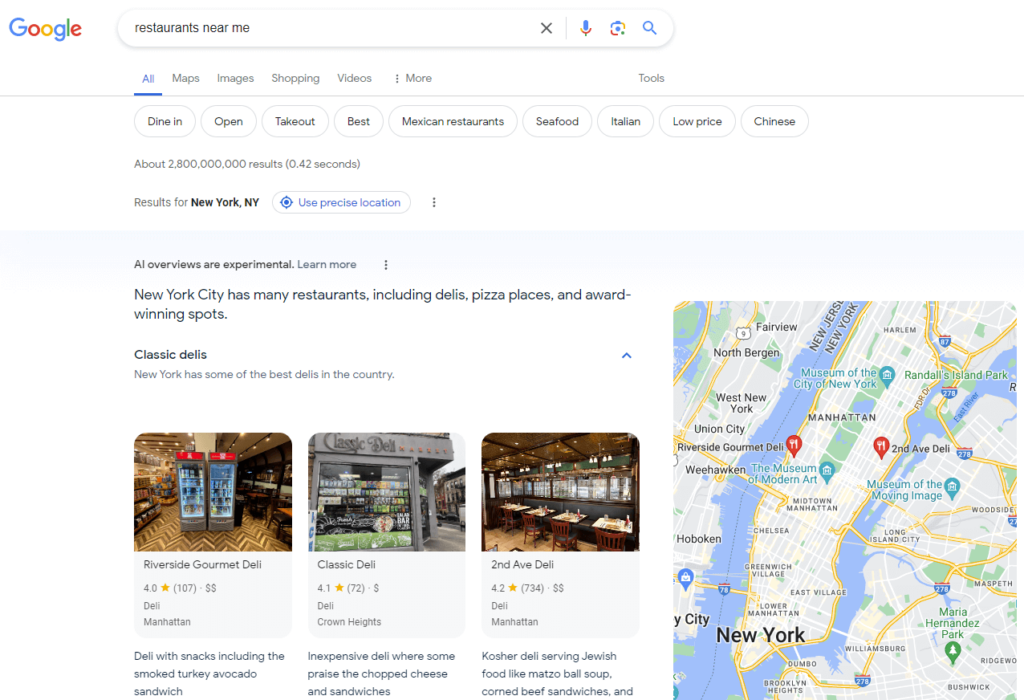
Search query “restaurants near me” (local)
Important Links
- Google documentation on AI Overviews
- Gemini 2.0 for AI Overviews
- Availability of AI-generated overviews
- Live data on the evolution of AIOs
AI Overviews Now Also in Germany, Austria, and Switzerland
Google officially confirmed on March 26, 2025, that the so-called AI Overviews—also referred to as “KI-Übersichten” in German-speaking regions—are now being rolled out in Germany and several other countries. Even before the announcement, they had sporadically appeared in German-language search results, but only as part of limited tests not visible to all users.
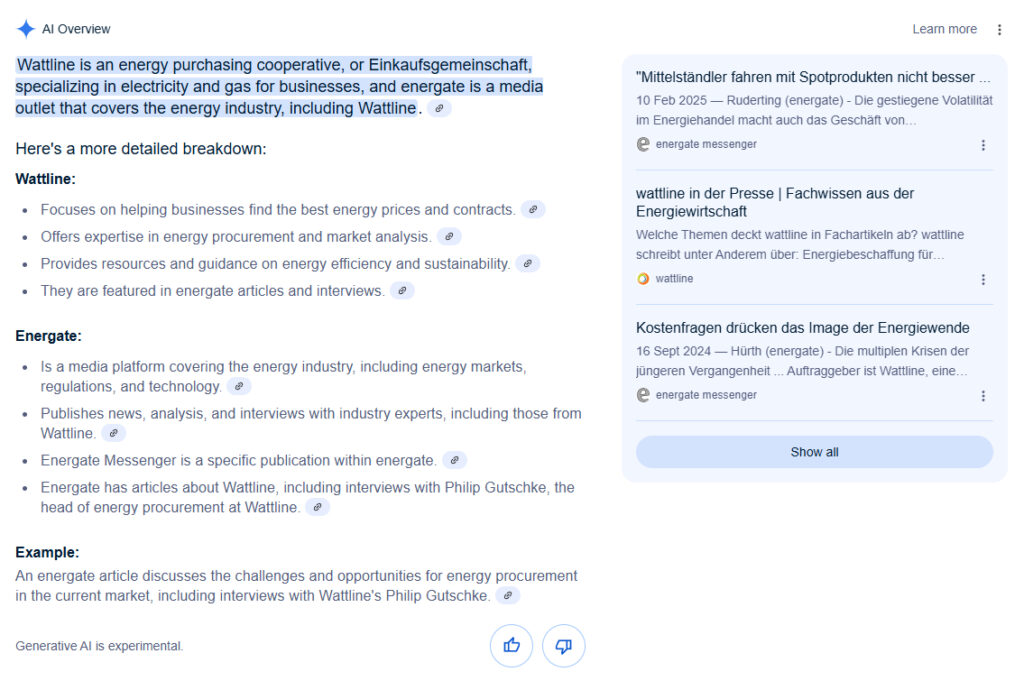
With the launch, AI Overviews in Germany are available in both German and English. In other countries, only English is initially available – such as in Belgium. Additionally, access restrictions apply: users must be at least 18 years old and logged into their Google account to use the feature.
The current country list includes:
- Germany (German, English)
- Austria (German, English)
- Switzerland (German, English, French, Italian)
- Italy (Italian, English)
- Spain (Spanish, English)
- Poland (Polish, English)
- Portugal (Portuguese, English)
- Ireland (English)
- Belgium (English)
According to Google, the decision for the expanded rollout was made after extensive testing and positive user feedback. The goal is to simplify finding information while simultaneously promoting the discovery of relevant websites.
Google AI Overview Launches in Germany – What Does This Mean for SEO?
With the rollout of Google AI Overviews in Germany, traditional search is fundamentally changing. Many website operators now face the question: How does this affect my organic visibility when Google already provides an answer directly?
The AI-based answers appear above the familiar organic search results – a development that puts existing SEO strategies under pressure and requires new approaches.
What you should do now to remain visible in AI Overviews:
- Adapt content strategy: Companies must ensure their content is optimized so it’s considered as a source in AI Overviews. This means providing concise and structured information that can be easily integrated into AI-generated summaries.
- Monitor visibility: It’s crucial to actively monitor your own presence in AI Overviews. Companies should regularly conduct SERP analyses to determine whether and how often their content appears in the new search results.
- Training and education: Marketing and SEO teams should intensively engage with the mechanisms behind AI Overviews to secure competitive advantages early.
The introduction of AIOs in additional European markets shows that Google will expand its search strategy in this direction long-term. Companies that adapt now can secure valuable advantages and benefit early from the new search function.
Important: The following data is based on a meta-analysis of current studies and reports from markets where AIOs have been available longer, including from Seer Interactive, Growth Memo (Kevin Indig), Semrush, Ahrefs, SurferSEO, SE Ranking, Zapier, SearchEngineLand, SEOClarity, Advanced Web Ranking, and Siege Media. The most important numbers and statements are supported by corresponding references. The data does not refer to Germany!
How Often Does Google Show AI Overviews? A Data-Based Analysis
- Average frequency: AI Overviews appear in currently 4.5–12.5% of search queries (depending on the study)
- Topic dependency: AI Overviews are particularly common in health, scientific, and technological search queries
- Device distribution: Mobile users see AI Overviews more frequently than desktop users
- Long-term development: Google plans a gradual expansion of AI Overviews once their quality has been optimized
After the initial hype came the sobering reality:
AI Overviews don’t appear with every search query – they’re used selectively. Earlier fears that Google would swallow all organic traffic through AI Overviews have not materialized. In fact, current studies show that AIOs appear in less than 10% of all search queries.
Immediately after the rollout in May 2024, some sources estimated that up to 42% of search queries contained AIOs. But with the public launch, Google significantly reduced the frequency. A study by SE Ranking found that AI Overviews appeared in only 12.47% of search queries in August 2024. By December 2024, broader analyses by SeoClarity showed an even lower prevalence: only 4.5% of the 120 million examined search queries led to an AI Overview.
But behind these average values lies a differentiated reality:
While in information-driven industries like health up to 67.5% or technology up to 23% of search queries were answered with an AIO, the frequency remained extremely low in commercial areas. In commercial searches, the AIO rate averaged below 6%. Google deliberately uses AI Overviews to provide users with reliable information faster – without endangering its own advertising platform.
Conclusion: AI Overviews are present but far from dominating Google Search. Information-heavy topics are particularly affected, while commercial searches continue to rely on traditional SERPs.
What Triggers AI Overviews? The Decisive Influencing Factors
- Informational intent: AI Overviews appear primarily in search queries seeking knowledge or explanations
- Complex questions: Multi-part or specific questions have a higher probability of triggering an AI Overview
- Long-tail keywords: The more specific the query, the more likely an AI-powered answer appears
- Lack of monetization opportunities: Google rarely shows AI Overviews for search queries that generate ad revenue (e.g., “buy laptop”)
Google AI Overviews don’t appear randomly but follow a clear pattern. Two central factors determine whether an AI-generated answer is displayed:
Search Intent and Query Complexity
AI Overviews almost always occur with information-driven searches. A study by Ahrefs found that AI Overviews appear in 99.2% of informational queries—exactly where users expect a comprehensive explanation. AI Overviews occur particularly frequently with W-questions (“How does…?” or “What does…mean?”) and complex multi-stage search queries.
Google itself emphasizes that AI Overviews appear especially when a traditional search would require multiple queries to deliver a complete answer.
Existing SERP Features and Monetization
An interesting observation: AI Overviews appear strikingly often in combination with Featured Snippets. An analysis by Advanced Web Ranking showed that 59.5% of AI Overviews simultaneously contained a Featured Snippet on the same SERP. Conversely, they’re rarely combined with Google Ads—presumably because Google doesn’t want to endanger its advertising revenue. SE Ranking found that only 13.51% of AI Overview SERPs also had ads displayed.
Implication for marketers: If your keywords already contain Featured Snippets or Knowledge Panels, there’s a high probability that Google is also testing AI Overviews there. Targeted optimization for these SERP features can therefore increase your visibility in AI Overviews.
How Do AI Overviews Affect the Click-Through Rate of SEO and SEA?
- CTR decline for organic results: In a study, the average click-through rate (CTR) dropped by -8.9% when an AI Overview was present
- Effect on Google Ads (SEA): The CTR of search ads fell from 21.27% to 9.87% when an AI Overview appeared on the SERP
- Increase in zero-click searches: Users already receive the sought answer in the AI Overview and click less on external sites
- Source citation: When a website is cited as a source for the AI Overview, its click-through rate increases by up to 80% compared to non-cited sources
The fear of massive click losses through AI Overviews is not unfounded. According to an analysis by Kevin Indig, the click-through rate drops by an average of -8.9% due to an AI Overview.
Why?
AI Overviews push traditional search results down. A study by Press Gazette found that organic hits were shifted down by an average of 980 pixels when an AI Overview was displayed. On mobile devices, where visible space is limited, this can mean that no organic result is visible without scrolling.
But there’s also a way to benefit from AI Overviews:
Source citation.
If your website is cited as a source in an AI Overview, you can still generate clicks despite lower organic visibility. Seer Interactive found that a citation in an AI Overview can increase CTR by more than 80%.
Interesting in this context:
Seer Interactive found that AIOs typically appear in search queries that already had a high number of zero-click searches previously. For search queries without AI Overviews, the click-through rate even increased year-over-year (2024-2025).
For SEA managers, the effects are also noticeable. In tests by Seer Interactive, ad CTR dropped significantly when an AI Overview appeared on the same SERP. AI Overviews thus seem to capture not only organic traffic but also paid clicks. However, it must be mentioned that AI Overviews rarely appear in commercial search queries. Long-term, this could motivate Google to expand paid placements within AI Overviews.
Conclusion: AI Overviews reduce organic and paid clicks, but especially in areas with many zero-click searches and low commercial potential. For these topics, the best strategy is to appear as a source in the AI Overviews themselves through targeted optimization.
How Does Your Brand Gain Visibility in AI Overviews?
The good news: There are clear patterns for which content is preferred in AI Overviews. Based on current studies, the following optimization strategies can be derived:
- Prepare Content Precisely and Structured:
Google prefers structured answers. Around 40–61 % of AI Overviews use lists or bullet points. Content already prepared in a clear step-by-step guide or table format has higher chances of citation. - Improve Organic Rankings:
A study by SeoClarity found that 99.5% of AI Overview sources come from the top 10 organic rankings. Traditional SEO therefore remains essential for appearing in AI Overviews. - Signal Authority and Trust:
Google prefers established sources. Wikipedia and YouTube are among the most-cited platforms. Brands with strong E-E-A-T signals (Experience, Expertise, Authoritativeness, Trustworthiness) therefore have better chances of appearing in AI Overviews.
How Must Content Creation Change Regarding AI Overviews?
Traditional SEO optimization is no longer sufficient to assert yourself in an AI-dominated search landscape. Those who want to appear in AI Overviews must adapt their content:
Clarity and Structure
AI Overviews prefer short, concise answers. Use meaningful headings (H2/H3) that signal questions or sub-questions, followed by crisp answer sections of about 40 words – just as you would optimize for Featured Snippets (which are significantly shorter).
Use Lists and Tables
Around 40–61% of AI Overviews contain bullet points or step-by-step instructions. Format content accordingly to increase the probability of citation.
Strengthen E-E-A-T
Google prefers trustworthy sources. Building authority through digital PR increases chances of being selected as a source.
Provide Holistic Answers
AI Overviews often combine multiple aspects of a question. Your content should therefore not only give a direct answer but also cover related sub-questions.
Regular Updates
AI Overviews preferentially use current content. Continuous optimization and updating of existing posts is therefore crucial. To deliver the necessary volume at high quality, AI-supported content workflows are essential.
The Truth About AI Overviews
Google’s search is evolving with AI Overviews toward an answer-engine model. Information-heavy, longer search queries with low direct conversion value are increasingly answered by AI Overviews. This relieves users but poses new requirements for SEO and content marketing.
Fewer clicks are a fact to live with, but…
Just because searchers already receive answers before clicking on a website doesn’t mean their purchase intent disappears (as long as AI chatbots don’t offer direct checkout).
What is lost to a certain extent for marketers and SEOs, however, is the ability to influence buyers on their own website before they make a purchase decision. Accordingly, it’s necessary to find new paths, new content-strategies, and new platforms to influence purchase decisions.
This was just the beginning – now it’s time to learn from the insights and make your strategy future-proof. We’re happy to support you with this!



Comment