Key Takeaways:
- Paradigm shift: AI search moves decisions before the click. Traditional traffic logic no longer applies.
- Budget logic: SEO and GEO budgets must not be distributed historically. What matters is where AI systems source information.
- Purchase decisions: In B2C, 40–55% already actively use AI search for product recommendations and purchase decisions; in B2B, 89% of buyers use generative AI throughout the entire buyer journey.
- Budgets & costs: Reasonable annual budgets start at €30,000 for small companies and range up to €3–8 million for corporations. What matters isn’t the amount itself, but the right distribution.
McKinsey shows: 50% of users actively use AI search today, and 20 to 50% of traditional search traffic is at risk. At the same time, B2B buyers name generative AI as one of their top information sources.
When decisions are made before the click, the question is no longer: How do we get clicks back? But: What do we invest in at all?
In this guide, you’ll learn how to properly distribute your budget by business model and what budgets are realistic by company size.
-
 Last updated: 6. February 2026B2B Marketing Trends & Priorities 2025/2026
 -
 Last updated: 28. April 2026SEO Trends 2026: Developing Strategies for the AI Era
 -
 Last updated: 12. February 2026Generative Engine Optimization (GEO) explained
I notice through conversations with prospects that many are overwhelmed. New technology, new tools, new gatekeepers, thousands of GEO agencies that feel like they’re a few months old – everyone’s shouting something about AI.
This guide is a real passion project for me to help you make better decisions and ultimately land with the right partner. It’s not about selling you something, but giving you orientation so you don’t fall into the same traps many are currently stumbling into.
I’m currently seeing mass inquiries from people who haven’t fully grasped the topic, and these are exactly the ones ending up with more or less helpful GEO-Agencies.
If you’re a marketing manager or procurement professional currently sending inquiries to GEO and SEO agencies with the goal of “GEO optimizing” “SEO pages,” asking how much it costs per page: STOP. Please take the time to read this guide. I promise you this will save your job.
Because 2026 will be the year when it becomes clear:
Those who still plan their SEO budget by clicks are thinking in the old world.
How Big Is the Influence of AI Search Today?
Many companies are currently wondering whether ChatGPT and other generative engines are really already so influential on our customers that we should be dealing with this topic.
I have to say, I was surprised myself how massive the influence already is.
Let’s look at three different studies:
McKinsey’s AI Discovery Survey (August 2025)
AI search is already the most popular information source among users:
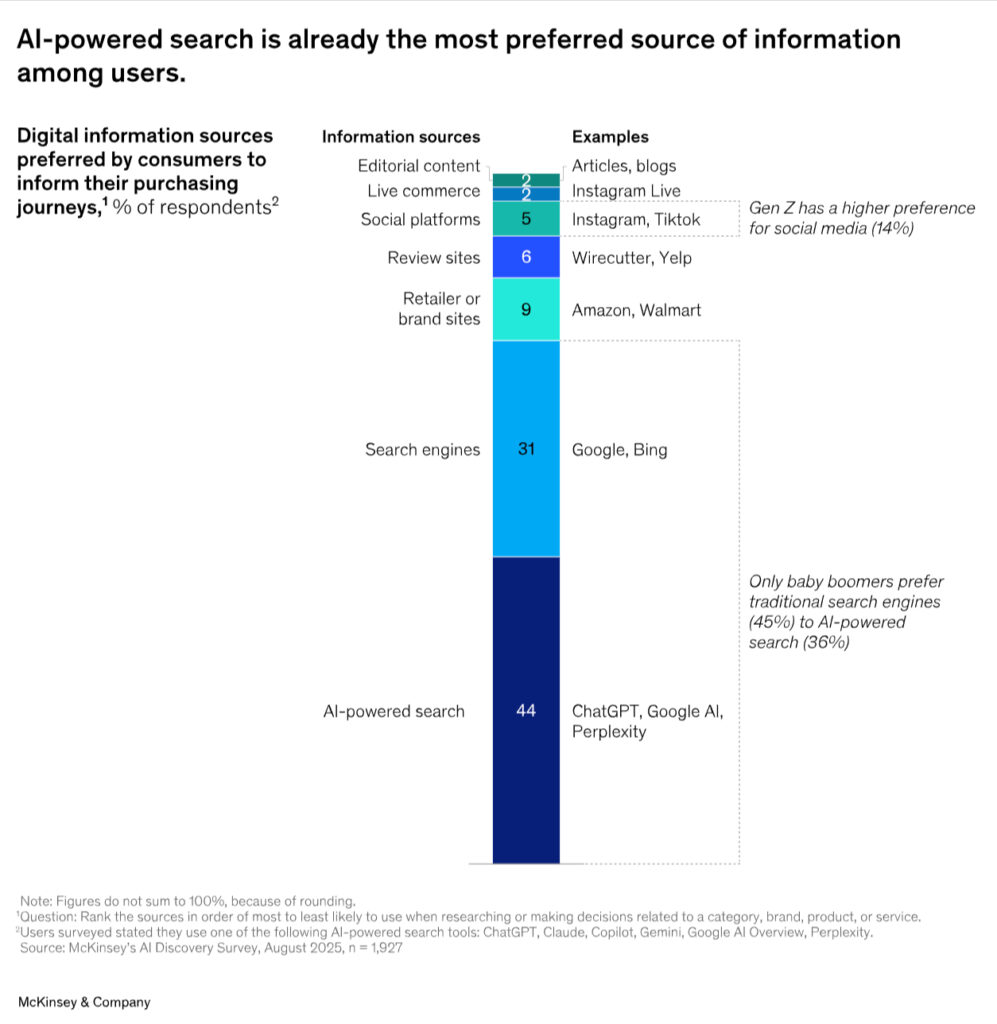
The chart above clearly shows that AI-Search isn’t coming sometime – it’s already here.
Consumers are already very actively using AI search along the customer journey:
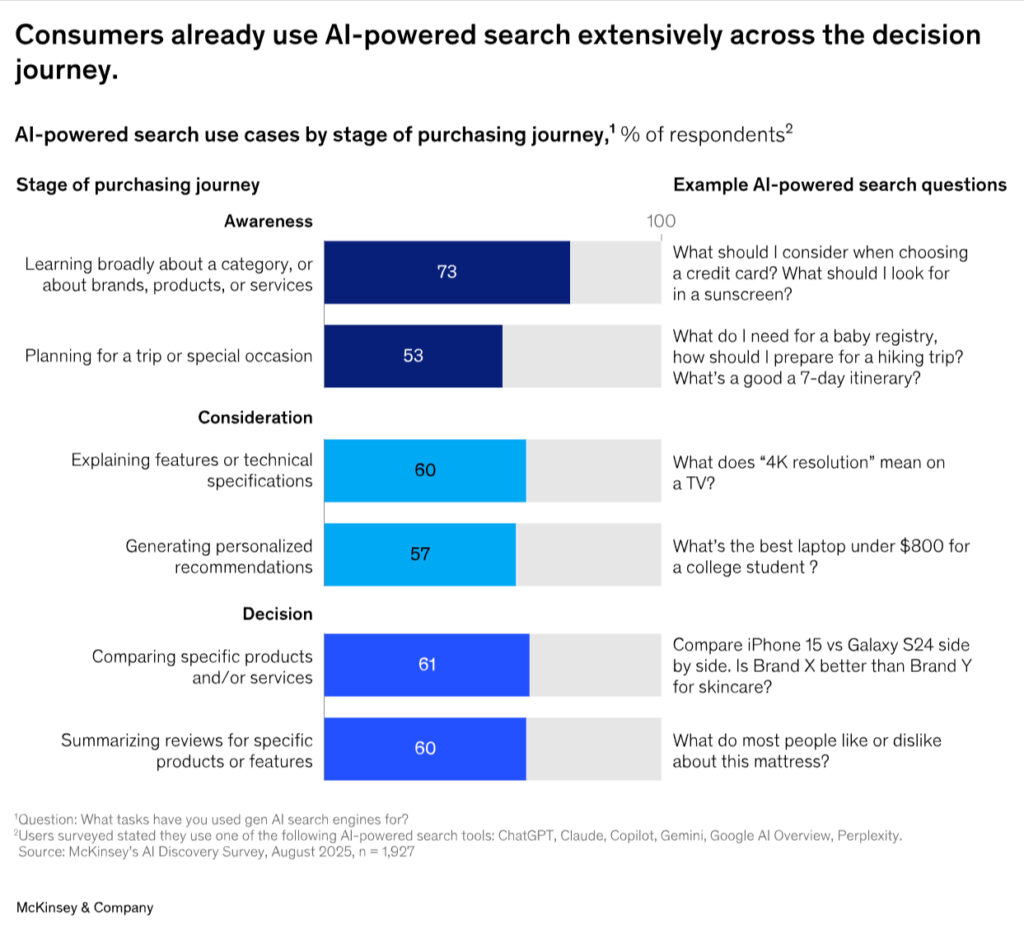
Many will now believe it might be different for B2B buyers. There’s a study from Forrester on this.
Forrester’s B2B Buyer Adoption Of Generative AI (November 2024
In less than two years, 89% of B2B buyers have adopted generative AI (genAI), naming it one of the top sources of self-guided information in every phase of their buying process. This data overview provides insights into how buyers are using genAI and the impact it is having on B2B buying based on buyers’ responses to Forrester’s Buyers’ Journey Survey, 2024.
Profound 2025 AI Consumer Journey Study (September 2025)
80 percent of users make more than half of their decisions based on dialogues with AI chatbots.
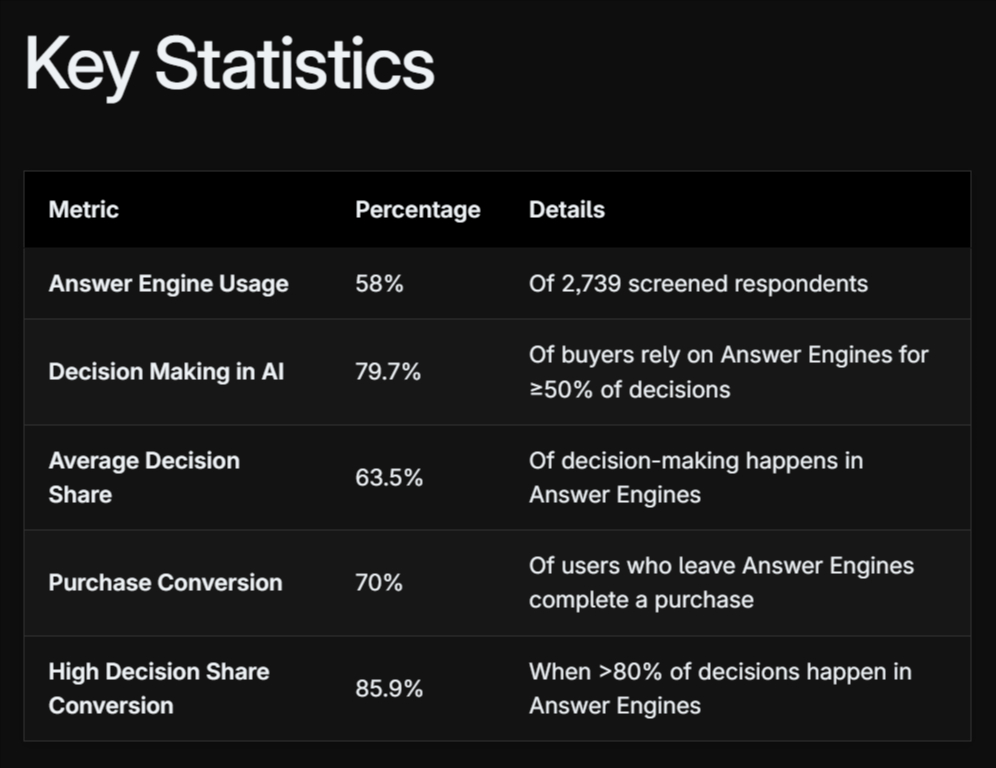
But then they buy elsewhere:
- Google: 24%
- Amazon: 20%
- Company website: 19%
- Physical retail: 15%
This means purchase decisions are shifting before the click.
The Website Remains Important, But It’s Often No Longer Where the Decision Is Made
SEO Budget Is No Longer Invested in Traffic
Many still see SEO budget as an investment in traffic, but revenue today doesn’t equal clicks.
Traffic is no longer a performance indicator. Clicks will decline, no matter how much budget you invest. Clicks have long been decoupled from demand.
Today there are still the ten blue links on Google, but I wonder for how long. After all, AI-Mode has also been rolled out in Europa since early October. Google itself has already announced that as the product improves, AI Mode could also play a more central role.
Search Engine Optimization (SEO) and Generative Engine Optimization (GEO) will henceforth revolve around influencing what happens before the click.
Both are inseparable. The click in the end is only transactional.
A Contemporary Approach to GEO and SEO Budget Distribution
With SEO and GEO, you invest in visibility along your target audience’s customer journey. This actively influences the purchase decision.
The question of whether this pays off or should be prioritized should have been answered by the studies above. Nowadays, everyone has a purchasing advisor in their pocket, and companies that don’t appear in these AI assistants will soon be forgotten.
The customer journey has changed dramatically within just a few years, accordingly:
Budgets must not be distributed historically now.
We must base our distribution on a new technological situation and a new filter between companies and customers.
In Which Areas Must Investment Be Made?
- Ecosystem presence, e.g.: Digital PR, comparison portals, user-generated content platforms, and review management
- Content, e.g.: AI-supported processes, updates, context richness
- Target audience research, e.g.: Customer intelligence tools, personas, journey mapping, market research
- Unique information, e.g.: proprietary data, expert insights, thought leadership
- Engagement & self-service, e.g.: Mini-tools, videos, graphics
- Technology & UX, e.g.: structured data, rich product feeds, Core Web Vitals, extractability
Example of Recommended SEO and GEO Budget Distribution
| Area | Recommended Share | Rationale / Derivation |
| Ecosystem Presence | 30 – 40 % | AirOps, XFunnel and McKinsey show that often third-party sites, not brands, are cited. These external signals (mentions, links, press, communities) are today’s strongest lever for visibility in AI results. |
| Content | 20 – 25 % | Focus on context richness and timeliness. |
| Technology, Semantics & UX | 15 – 25 % | Technical cleanliness, structured data, and good UX are prerequisites for content to be extracted by language models (LLM) and presented optimally to users. Not a direct growth lever, but an indispensable foundation. |
| Target Audience Research | 10 – 15 % | The better you understand how your target audience thinks, the more targeted you can align content and online-PR. High strategic value, even if short-term effects are hard to measure. |
| Unique Information | 10 – 15 % | LLMs prefer sources with information gain. Companies that provide proprietary data or perspectives are cited more frequently and perceived as authorities. |
| Engagement & Self-Service | 5 – 10 % | Interactive content and visuals help convert fleeting visibility into trust. Project-based investment block. |
Is this the perfect SEO and GEO budget distribution for every company? No, of course, it ultimately depends on the specific business model, goals, starting situation, and market environment.
Potential GEO/SEO Budget Distributions by Business Model
B2B Financial Technology
| Area | Recommended Share | Rationale / Derivation |
| Ecosystem Presence | 35 – 45 % | In financial technology, external credibility is central. Trade portals, media mentions, and co-branding contributions massively increase visibility and trust in LLMs. |
| Content | 20 – 25 % | Strategic content (whitepapers, use cases, expert insights) creates authority. Focus on quality, consistency, and information density, not volume. |
| Unique Information | 15 % | Proprietary studies, analyses, or benchmarks are cited particularly frequently and create “information gain” for LLMs. In regulated industries, proprietary data depth becomes a differentiating factor. |
| Technology, Semantics & UX | 10 – 15 % | Technical hygiene remains mandatory (structured data, Core Web Vitals, accessibility), but not a main lever. Important is content extractability for AI systems. |
| Target Audience Research | 5 – 10 % | In B2B fintech, decisions are often collective (CFO, CMO, CTO). Buyer journey mapping is necessary to tailor content to different decision-making roles. |
| Engagement & Self-Service | 5 % | Interactive tools can support trust (e.g., cost simulations or case tools), but are supplementary. Focus is on progress in the customer journey, not entertainment. |
B2C E-Commerce Retailer
| Area | Recommended Share | Rationale / Derivation |
| Technology, Data & UX (Feed Quality, Structure, Performance) | 30 – 40 % | Clean data feeds, structured product information, Core Web Vitals & UX are crucial for AI search systems to correctly understand and display products. Biggest lever for visibility + conversion. |
| Content (Product + Discovery Content) | 20 – 25 % | Focus on product descriptions & inspiration content. Important: Freshness + User Intent Alignment. Automated processes. |
| Ecosystem Presence (UGC, Comparison Portals, Reviews) | 15 – 20 % | External sources like reviews, price comparisons, forums shape perception in AI answers. This is about rating management, partnerships & influencer trust. |
| Engagement & Self-Service (Product Finder, Quiz, Visualizer) | 10 – 15 % | Interactive experiences increase trust in products and reduce return rates. Mini-tools like style advisors or comparison calculators help accelerate decisions. |
| Target Audience Research (Behavior Analytics, Attribution) | 5 – 10 % | Data-based insights into customer intent and channel mix are necessary to continuously improve content strategies. |
| Unique Information (Data, Proprietary Insights) | 5 – 10 % | Proprietary tests, benchmarks, or product comparisons create differentiation, but less central than in B2B. Important only for brand trust and LLM citations in high-involvement industries (e.g., tech). |
B2B Energy Industry
| Area | Recommended Share | Rationale / Derivation |
| Ecosystem Presence (Trade Media, Industry Portals, Universities, Partner Networks) | 35 – 45 % | Technical trade sources, associations, research institutes, and partner communication determine which brands appear in LLM answers. This is where trust and authority emerge. Most important lever for visibility and relevance. |
| Content (Expertise, Application, Research, Updates) | 20 – 25 % | Content with technical depth, practical relevance, and continuous maintenance ensures relevance for search and AI systems. Less marketing storytelling, more technical expertise. |
| Unique Information (Data, Studies, Case Studies) | 15 % | Proprietary measurement series, energy efficiency analyses, ESG data, or innovation reports create “information gain.” |
| Technology, Semantics & UX | 10 – 15 % | Clean structure, accessible data sheets, structured data are crucial for AI systems to correctly interpret content. |
| Target Audience Research (Industry Analysis, Stakeholder Mapping, Thought Leadership Alignment) | 5 – 10 % | Focus on market segments (e.g., pharma, chemicals, manufacturing). Serves to target content and PR to decision-maker groups. |
| Engagement & Self-Service (Calculators, Tools, Visualizations) | 5 % | Tools (e.g., electricity savings calculators, energy demand calculators) are very useful for users to progress independently. |
So Now the Question Naturally Arises:
How much SEO and GEO budget is actually realistic to implement all this meaningfully?
GEO/SEO Annual Budgets: Costs for Orientation
| Company Size | Annual Revenue | Realistic Annual Budget (without internal personnel costs) |
| Micro-enterprises / Start-up | < 5 Mio. € | 30.000 – 100.000 € |
| Small Companies | 5 – 10 Mio. € | 100.000 – 200.000 € |
| Small Mid-Market | 10 – 25 Mio. € | 200.000 – 400.000 € |
| Mid-Market | 25 – 100 Mio. € | 400.000 – 1 Mio. € |
| Large Mid-Market / Corporate Subsidiaries | 100 – 500 Mio. € | 1 – 3 Mio. € |
| Large Corporation / International Brand | > 500 Mio. € | 3 – 8 Mio. € |
Disclaimer:
The EU has its own definition of when a company is small, medium, or large, but honestly, it’s pretty useless for this classification. A company with €80 million in revenue and a small marketing team functions completely differently from a real corporation.
A New Way of Thinking About SEO and GEO Costs
AI search already massively influences potential customers of companies today.
AI search isn’t a technological fad, but a paradigm shift. Decisions no longer emerge on search result pages, but in dialogues with systems that filter, curate, and decide which brands even come into question. Potential customers get answers instead of having to browse countless pages.
This affects not just SEO, but the entire digital access to information, attention, and revenue.
For me, this isn’t a break with the past, but its logical evolution. We’ve always understood SEO as strategic translation work—between brand, company, person, and machine. This competence remains; it just shifts its focus:
From traditional search engines to generative systems, from rankings to relevance in dialogue along the customer journey.



Comment