
Key Takeaways:
- Out of the AI experimentation phase: Those who consistently implement AI workflows and embed them in an ROI framework increase output and business impact even with stagnating budgets.
- New buyer journeys: Purchase decisions are migrating to chatbots and AI search engines. Brands must systematically secure their visibility in these environments.
- Hybrid purchasing processes: Self-service is in demand, but sales remains indispensable for ensuring context, security, and quality in customer decisions.
- Marketing as buyer enablement: Instead of collecting leads, it’s about actively supporting purchase decisions—through content assets, close integration with sales, and clear value communication.
CMOs and marketing leaders continue to face massive budget pressure while AI simultaneously causes expectations to explode.
In this guide, we’ll look together at which trends in B2B-marketing really determine relevance, attention, and impact.
If you want to clearly prioritize your marketing budget for 2026, you’ll get concrete guardrails for it here.
-
 Last updated: 5. October 2026Top 10 Marketing Trends and Priorities 2025/2026
 -
 Last updated: 5. October 2026Understanding Google AI Mode: Overview & Functions
 -
 Last updated: 5. October 2026Answer Engine Optimization (AEO): AI visibility in 2026
B2B Marketing Trend #1: Unlock the Potential of AI in Marketing
Those who see AI as ChatGPT gimmicks waste potential.
Why Is This Important?
AI is fundamentally changing the entire marketing landscape – from content creation to customer journeys to analytics. At the same time, budget pressure is real: companies want growth even when budgets stagnate or decline depending on the industry. With AI comes the expectation that you achieve significantly more with the same resources.
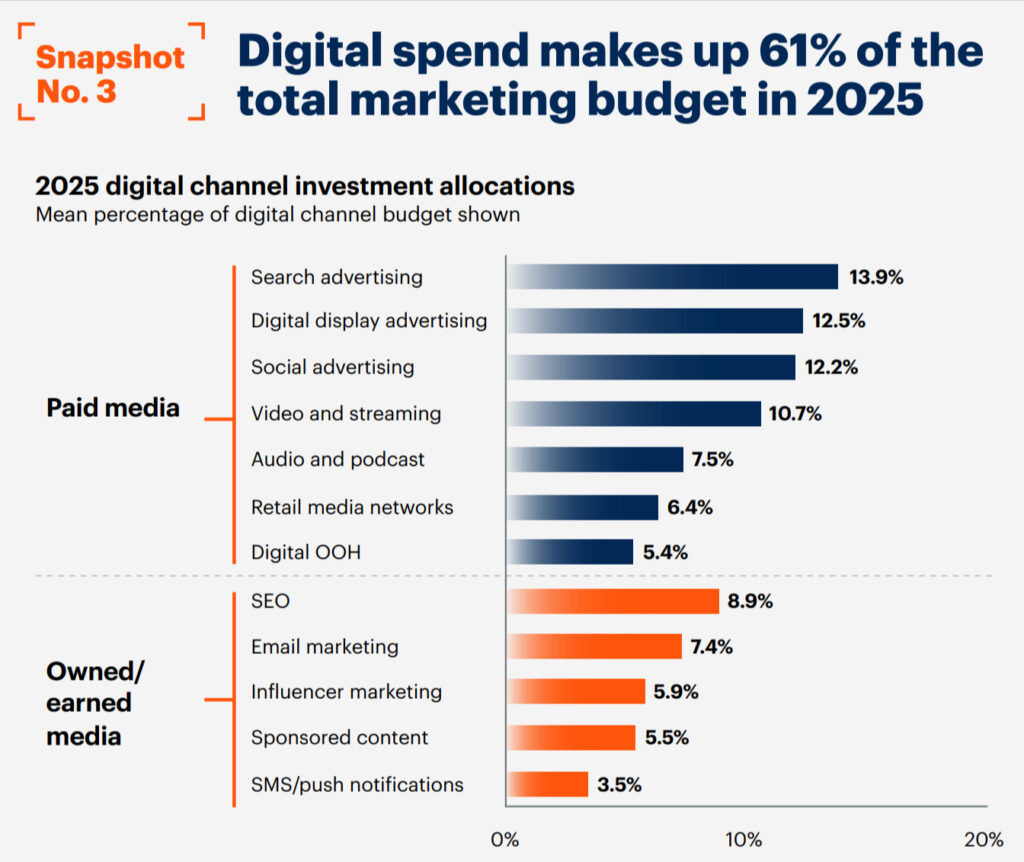
In 2025, 61 percent of marketing budget flows into digital channels. But offline is anything but dead. Especially in B2B, events remain a large budget item. In general, I believe that in an AI world, human contact becomes more rather than less important.
The problem: Many B2B companies struggle to integrate AI. On one hand, because there’s no single company-wide AI strategy. It’s always about specific, differentiated use cases. On the other hand, because central top-down approaches paralyze progress while competitors in marketing already work faster, more personalized, and more scalably.
AI isn’t a game-changer in all areas, but where workflows and agents fit, it delivers extraordinary results.
What’s the Goal?
The goal must be to build a scalable AI-powered marketing engine that delivers more output and business impact even with stagnating budgets.
AI must finally get out of the experimentation corner and out of the “AI black market.” Because the fact is: everyone uses AI—even if it’s officially banned in the company. It belongs in a robust ROI framework for selected cases.
It’s important to find the right balance: between human strategy & creativity and AI automation. For me, the future lies with marketers who think like engineers and marketers who are exceptionally creative. Everything in between will have a hard time.
How Do I Achieve This Goal?
1. Set Up ROI Framework
Define use cases with high potential and develop a model for how their success becomes measurable – such as through time savings, lead growth, or customer retention. You need metrics that convince management: not just input metrics (“more content”), but business metrics with clear influence on revenue and pipeline.
Example: A large B2B company in electrical engineering still doesn’t use AI in marketing today. The reason is that a company-wide AI concept is being developed. A comprehensive AI strategy where everyone gets to have their say. The result: no progress.
2. Strategic Implementation for High-Impact Cases Instead of Siloed Solutions and Central AI Strategies
“We use ChatGPT” is not a strategy. Nor is a company-wide master strategy.
What matters are specific, actionable cases: simple processes in Custom GPTs, complex workflows like content production in automated pipelines. In parallel, employees must be trained and brought along.
3. Establish Governance
With workflows, roles, reviews, guidelines, and knowledge databases are covered. AI output is thus brand-compliant, compliant, and repeatable.
4. Ensure Balance
AI creates speed and “capacity,” humans provide context, creativity, and differentiation. The goal is to free up resources for positioning, thought leadership, and bold ideas.
If AI enables us to have more output with the same budgets, the next question arises:
What do we use the freed-up time for? And this is exactly where it’s decided whether brands seem interchangeable or truly differentiate.
B2B Marketing Trend #2: Marketers Must Invest Their Time Where It’s Most Valuable
Why Is This Important?
Generative AI has massively accelerated content production. From our experience, depending on the format, up to three times more content can be created at the same quality.
With AI-agents that independently complete tasks, human focus shifts even more: away from production, toward strategy and creativity.
The problem: AI can make brands interchangeable. People build relationships with people. When anonymous brands also create their content with AI, they gradually lose their connection to the target audience.
In the end, it’s about a single currency: attention. In a world full of AI content, the question is: Who gets it?
What’s the Goal?
Marketing teams should be relieved by AI agents to invest their time in human differentiation. AI is co-pilot, not creator.
Personalized experiences are mandatory because generic content drowns in the masses. AI opens new possibilities here, e.g., in Account Based Marketing with individual microsites or hubs per target company. So you can build hyper-relevant, data-based experiences.
Beyond the website: Creator First instead of Brand First. I like the idea here from Kieran Flanagan of HubSpot. Channels like YouTube, podcasts, Substack, or LinkedIn reward personalities more than anonymous corporate brands.
How Do I Achieve This Goal?
1. Fully Automate Standard Content
Any standard content, such as FAQs or product descriptions, should be created nearly 100 percent with AI. Yes, this is easily possible with clean knowledge databases + brand guidelines and off you go. This frees up time and budget for differentiating content, such as cases, thought leadership, research.
2. Try Out AI Agents
Test initial AI agent solutions for simple marketing tasks. Instead of watching the hype and suffering from FOMO, you gain first-hand experience this way. A simple starting point for experiments is, for example, Relevance AI.
3. Ensure Human-in-the-Loop
What’s often done wrong here from my perspective is that checking only happens at the end. With our AI workflows, depending on the content format, we have editorial intermediate steps with a human-in-the-loop.
4. Rethink Creativity
As mentioned before, from my perspective, we’ll need marketers who think like engineers and marketers who are exceptionally creative.
And that’s exactly where the next big shift lurks:
Even the most creative content is worthless if it doesn’t appear in the new information systems at all. The buyer journey is migrating to chatbots and AI search engines.
B2B Marketing Trend #3: Buyer Journey Shifts to Chatbots and AI Search Engines
Even today, the B2B customer journey is already dominated by chatbots and AI search engines.
Why Is This Important?
According to Gartner, by 2027, 95% of B2B buying journeys will start in a language model. A Forrester-study from 2024 shows: Even then, 89% of B2B buyers named generative AI as one of their most important sources in every purchase phase.
Today, approximately 80% of buyer journeys start with Google. That’s exactly why Google is transforming itself into a chatbot. First with AI Overviews, and as you can already see in the USA, UK, and more than 130 countries worldwide, with AI Mode.
B2B brands that don’t appear in chatbots and AI search engines along the buyer journey will have a very difficult time in the future.
What’s the Goal?
B2B companies must ensure their brand, content, and products are visible in AI systems. To formulate this concretely as a KPI: increase your Share of Voice in chatbots and AI search engines along the buyer journey.
How Do I Achieve This Goal?
1. Map Journey in Prompts
Map your target audiences’ journeys in the form of prompts and determine your AI visibility based on this with a tool like Peec.ai.
2. Close Content Gaps
Now you should see your status quo and understand what’s typically cited in your niche. With this knowledge, we want to close gaps in the buyer journey on and off the website. This means we must publish the right formats and content on our webpage. But we also mustn’t neglect what happens on the web around our brand.
Example: A large SaaS company whose performance in generative search environments strongly depends on being listed high in relevant comparison portals. The path there: first get into the lists, then collect reviews, and finally invest in paid promotion.
3. Restructure Content
At the same time, content must be structured so that answers can be easily extracted by chatbots.
For a deep dive, I recommend the following video:
We’re currently seeing the transformation from pages to answers to actions.
If decisions are already prepared early in AI environments, the quality of the later purchase journey matters. And there it shows: A pure self-service process isn’t enough; without sales, deal quality declines.
B2B Marketing Trend #4: A Combination of Self-Service and Sales Increases Deal Quality
Self-service wins purchases, sales secures perception.
Why Is This Important?
75% of B2B buyers, and I’m one of them, want a sales-free purchasing process. But now it gets interesting. Pure self-service purchases lead to buyer’s remorse 1.65 times more often. Buyers who go through a mixed customer journey are 1.8 times more likely to close a high-value deal.
What’s the Goal?
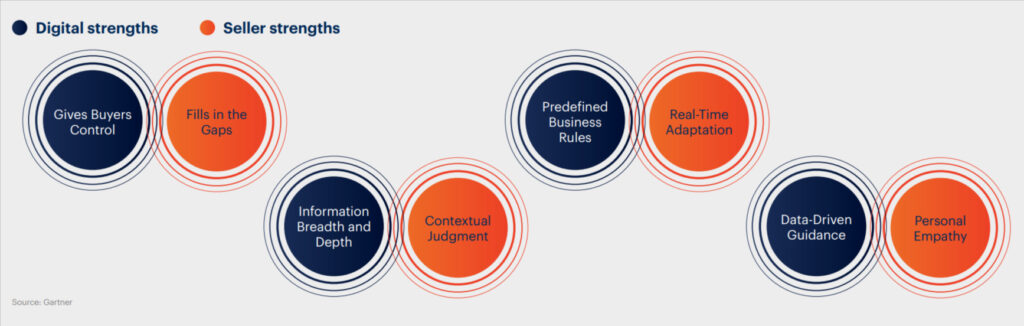
On one hand, we must respect buyer autonomy, but at the same time ensure that decisions are well-founded and value-creating for the buyer. We must design the purchasing process so buyers get the best of both worlds: self-service for efficiency and independence, and sales for additional, individual context, security, framing, and tailored support.
How Do I Achieve This Goal?
1. Develop Digital Self-Service Tools
We’ve already talked about this in the episode on no-code tools. You need ROI calculators, product configurators, and self-assessments. Depending on what you sell or what services you offer: mini-tools that help make independent progress.
2. Build Exit Points into the Journey
From our experience, these work well:
- On-demand demos
- Individual analyses
- Chat with an expert
3. Use Sales as Amplifier
Sales is responsible for filling information gaps, providing input on a very specific context, offering individual exceptions, and giving the whole thing a positive frame.
This brings us to perhaps the most important perspective shift:
Marketing can no longer define itself through leads. It’s about actively supporting purchase decisions.
B2B Marketing Trend #5: Position Marketing as Buyer Enablement Instead of Pure Lead Generation
Leads are a byproduct. Marketing must systematically influence purchase decisions.
Why Is This Important?
We know from data from Google and the Boston Consulting Group that the digital customer journey is highly complex. Classic funnel concepts help us bring order to chaos. But from my perspective, they’re also an abstraction that leads to the customer journey being designed less lovingly.
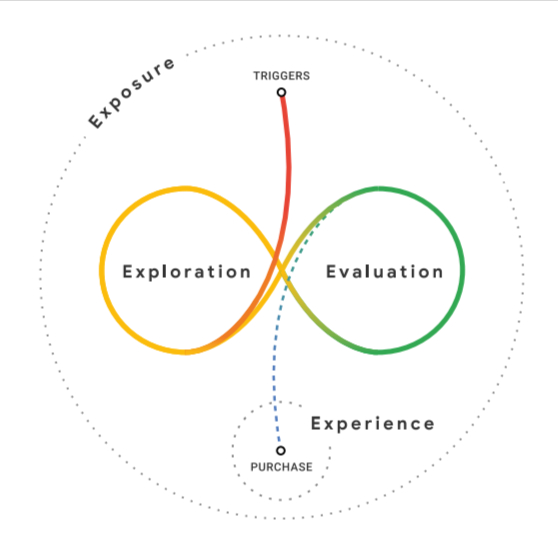
Potential prospects don’t want to be collected and processed, but supported on their way to a secure purchase decision.
Data shows: Deals are significantly more likely when buyers encounter Value Framing and Value Affirmation along the way.
What’s the Goal?
The statements that marketing probably hears most often at B2B companies are:
- Lead quality is poor
- We don’t get enough leads
A strategic thought I like here is to rebuild marketing from a pure lead-volume driver to a buyer enablement engine.
Of course, it’s essential that marketing and sales work closely together and tackle this process hand in hand. Especially in combination with generative engines, this exchange will be unimaginably valuable.
How Do I Achieve This Goal?
1. Design Content as Decision Assets
Generic top-of-funnel content is dead. That much is clear. Together with sales, it will be about understanding pain points, objections, and doubts and forging matching content, like comparison tables, checklists, or ROI models. Tailored to the entire buyer journey.
2. Synchronize Marketing & Sales
For this to work, marketing and sales need shared dashboards with intent data and customer journey insights.
Your Next Steps
B2B marketing trends 2026 will be determined by two forces: budget pressure and AI-driven expectations. Those who act now gain an advantage—not by optimizing a bit everywhere, but by consistently turning the decisive levers:
- Get AI out of the experimentation corner: Away from individual tools, toward clear workflows with measurable ROI
- Invest freed resources in differentiation: Creativity, thought leadership, and buyer enablement determine attention and perception
- Rethink buyer journeys: Secure visibility in AI search systems and design hybrid purchasing processes that meaningfully connect self-service and sales
The coming months are a key moment: companies that now boldly move toward AI-powered marketing engines, buyer enablement, and true differentiation are shaping tomorrow’s rules of the game. Everyone else risks drowning in a sea of generic content.
If you want to find out where your biggest levers for 2026 lie and how to use them systematically, talk to us.


Comment