
The Key Takeways:
- AI is already the top information source for many users, ahead of traditional search engines.
- Generative Engine Optimization (GEO) isn’t the next stage of SEO: SEO is about ranking in search results, GEO is about getting recommended in the AI’s answer.
- AI visibility comes from three building blocks, entity, validation, and community, built consistently over the long term.
- GEO only works across departments: companies with integrated teams report significantly more traffic and leads from AI platforms, according to recent study data.
Picture a personal assistant that knows you, anticipates your needs, and quietly manages your relationship with the digital world in the background. This isn’t science fiction. It’s the direction the web is already moving in.
Not one single assistant, but many, built into every device and every interface: ChatGPT, Gemini, NotebookLM, various Copilots, and whatever comes next.
On June 3, 2026, Cloudflare published data that makes this shift tangible: most internet traffic is no longer human. It’s bots and AI agents crawling the web, evaluating it, and packaging it up for people. The internet isn’t built primarily for humans anymore. It’s built primarily for machines that curate for humans.
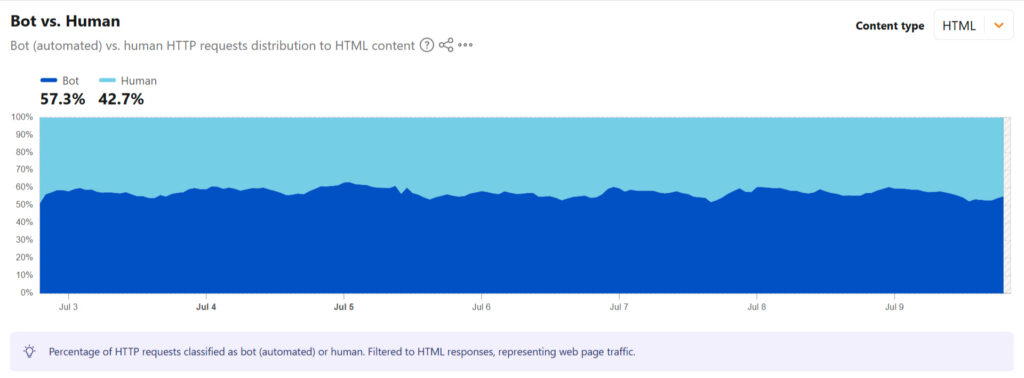
For companies, that’s a new paradigm. Anyone who still thinks AI visibility is a niche concern for SEO specialists is underestimating how far this reaches. It touches every department that communicates with the outside world.
Why Digital Visibility Is Fundamentally Changing
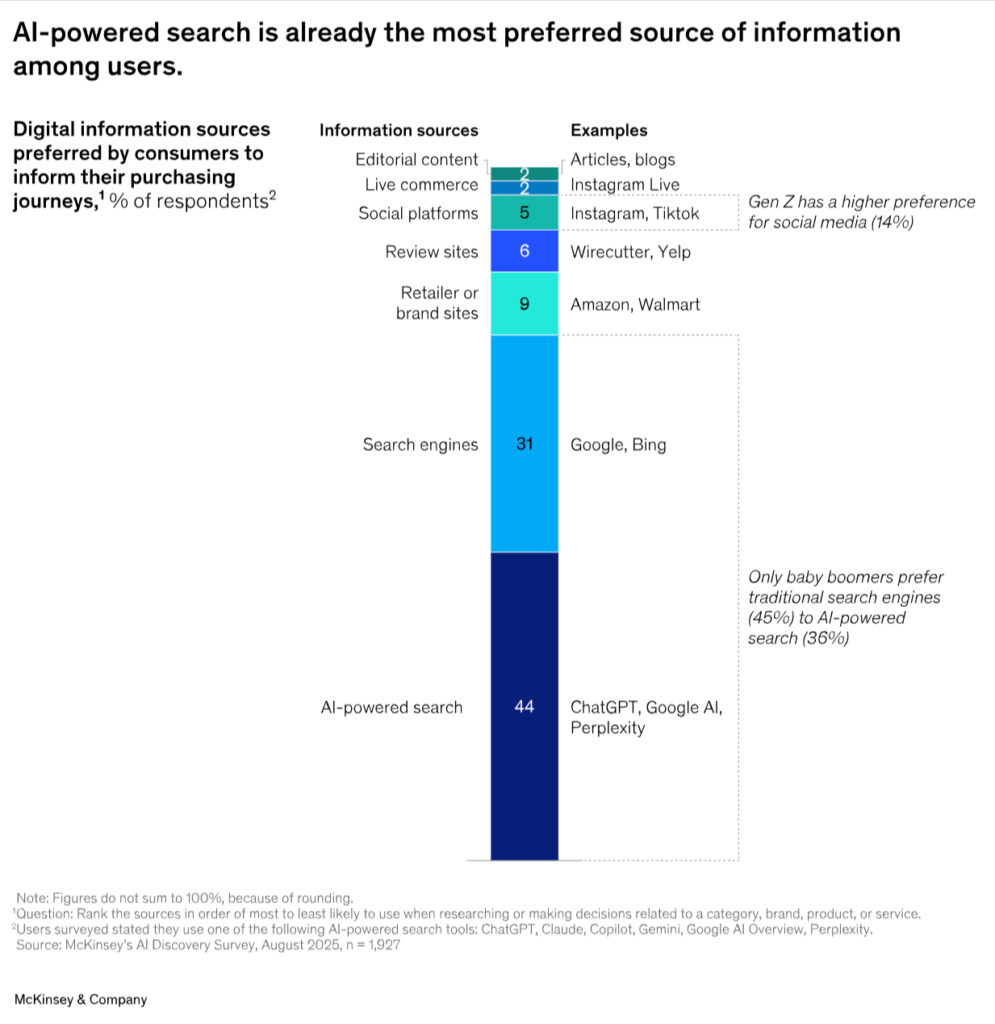
AI is already the number one source of information today, ahead of traditional search engines, online stores, review sites, and social media.
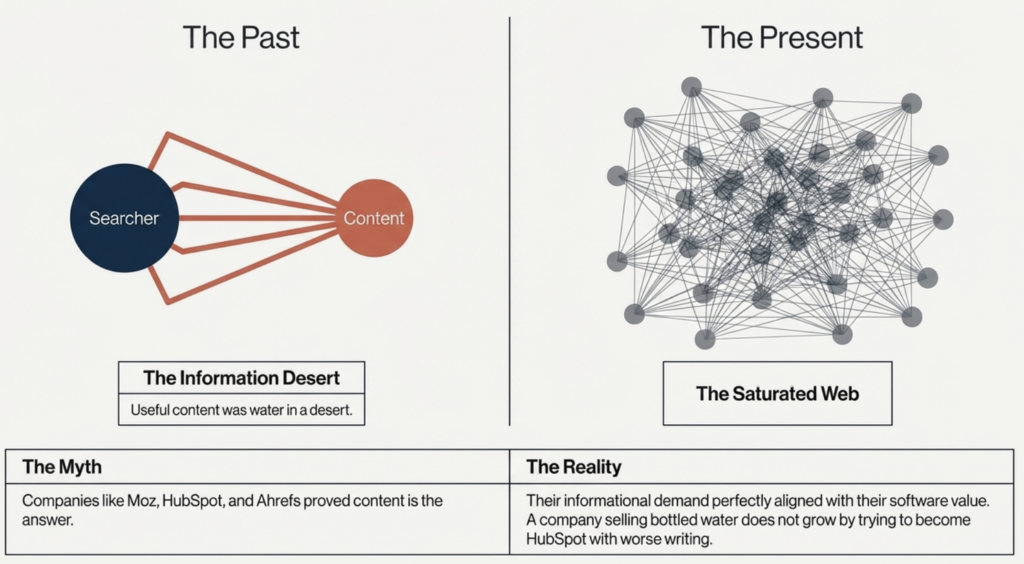
The web itself has changed fundamentally. Back in the day the internet was an information desert. For a lot of topics, there simply weren’t any answers yet. In 2026, we have the opposite problem: a saturated web where something already exists for nearly every question you could ask. For a long time, the real challenge was finding that information at all. AI solves exactly that problem, and it solves it radically.
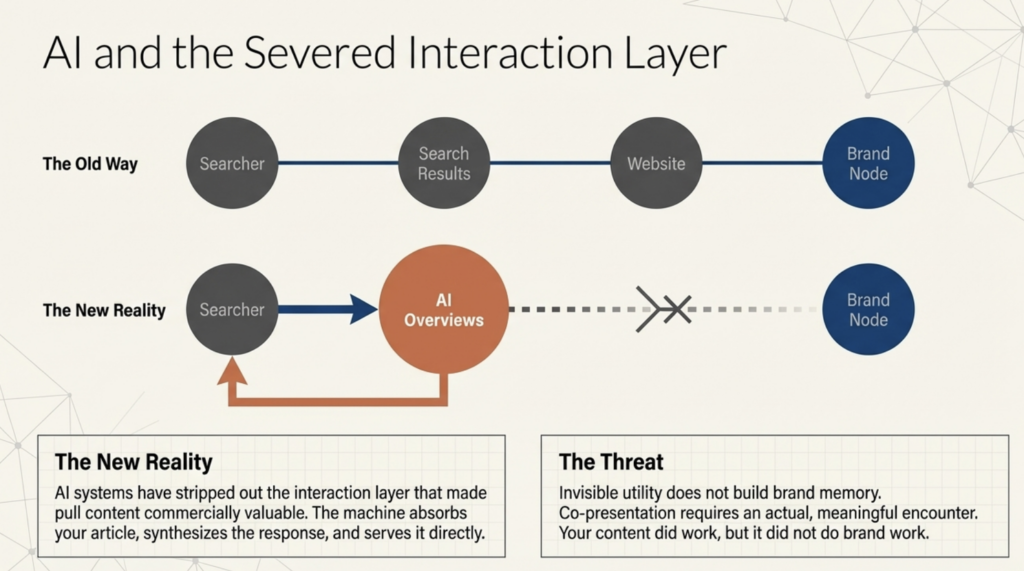
That blows up the old content business model: produce content to rank in search results and pull traffic to your own website. A system now takes your content, condenses it along with other sources, and hands the user a direct answer. Roughly half of the sources it draws on get cited, if that.
At best, your brand shows up as a fragment inside an agent’s answer. Simply answering general knowledge questions has become almost worthless as a result. What matters now is a different question: Does my brand have a reason to exist? Does it do something demonstrably better or different for a clearly defined audience?
Trust isn’t holding this back, either. Recent numbers on Google’s AI Mode make that clear: 88 percent of users trust the AI’s recommendations without doing any further research themselves.
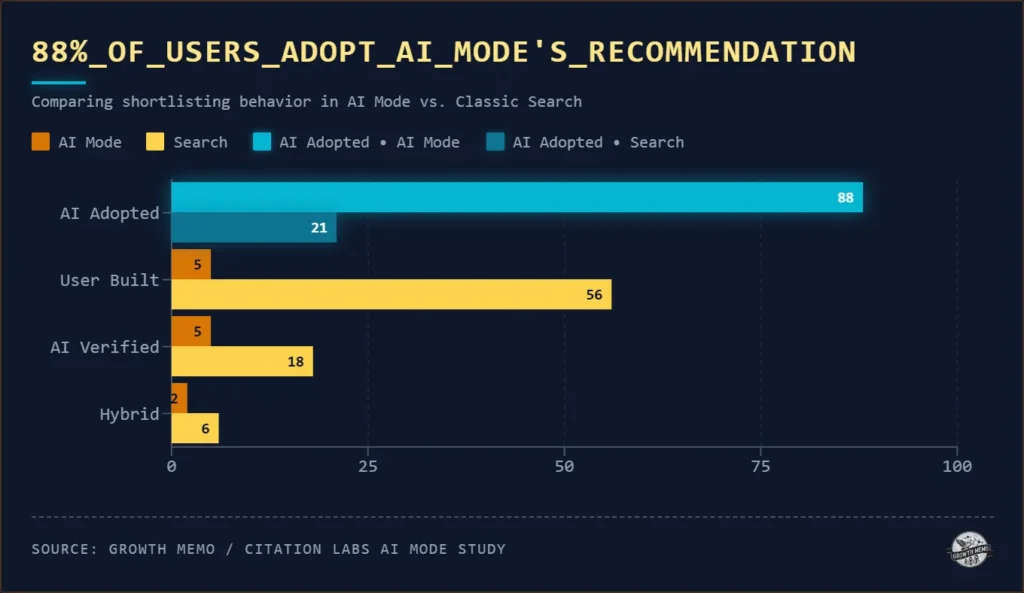
An older but still highly relevant University of Toronto study points to the same conclusion: AI actively guides people through decision-making processes and offers concrete recommendations, even for major purchases like cars or financial advice.
And those recommendations aren’t just talk. According to a recent Similarweb study, users are up to 2.5 times more likely to visit a brand within seven days after receiving a relevant AI recommendation. AI visibility isn’t a soft brand metric. It’s a lever with a direct impact on revenue.
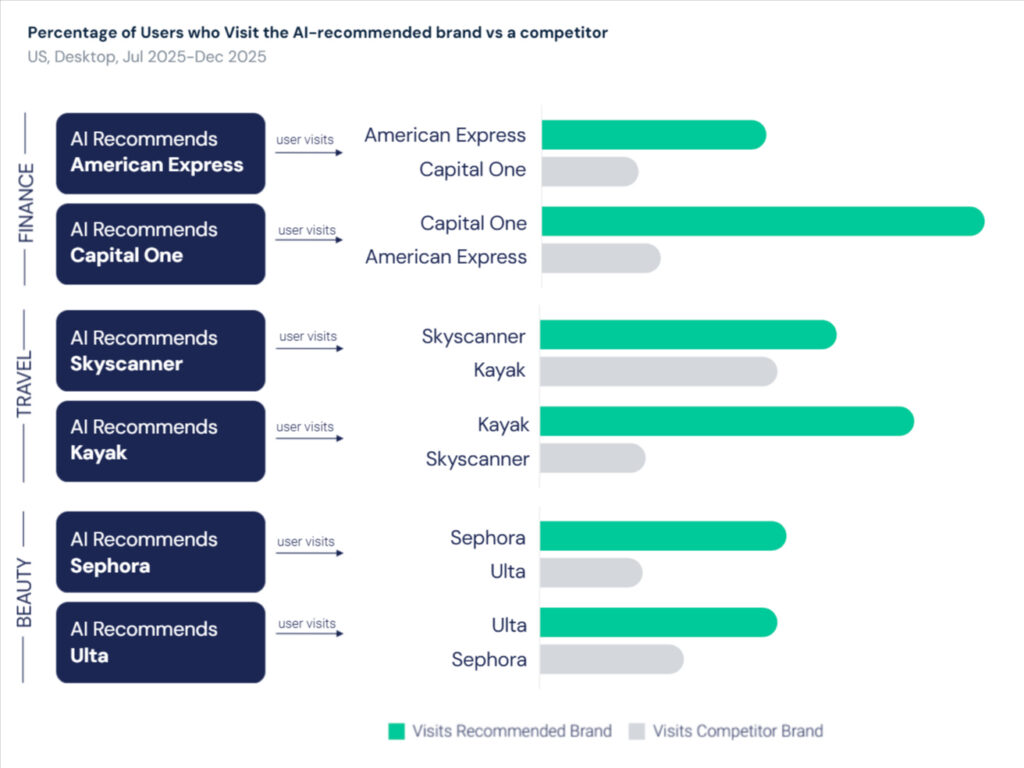
That makes AI a new gatekeeper between brands and their audiences, and a considerably less predictable one than a traditional search engine. This gatekeeper decides both whether a brand reaches its audience at all, and how that brand gets portrayed based on every source available online.
Brand value builds up over years. AI-generated content can damage it badly through a handful of critical voices or inaccurate information. Companies that just watch this shift instead of actively shaping it will lose attention and trust over time, with exactly the stakeholders who increasingly ask AI first instead of the company itself.
SEO, AEO, and GEO: Telling Them Apart
There’s still no single, universally agreed-on term for improving visibility in AI search. Terms in common use include Generative Engine Optimization (GEO), Large Language Model Optimization (LLMO), Answer Engine Optimization (AEO), or simply AI search engine optimization (AI SEO, SEO for AI). Major companies like Andreessen Horowitz and McKinsey mostly use the term Generative Engine Optimization.
SEO expert Dan Petrovic nailed this back in 2018, long before the current AI hype:
A good SEO strategy has to keep every marketing channel in view, in order to convince Google’s AI that a brand is relevant, significant, and authoritative in its context.
He saw where things were heading early on.
Classic SEO works like an interpreter between people and search engines. Users type in keywords, refine their query step by step, and end up with a list they have to work through themselves. With AI assistants, that translation step nearly disappears. Users just describe what they want in natural language, the AI usually grasps the intent right away, and delivers a finished answer instead of a list of links.
That points to the core distinction: SEO is about getting pages to rank for keywords. GEO is about getting recommended inside the answer itself. That’s also why GEO isn’t simply the next evolutionary stage of SEO, as it’s often described. It’s its own discipline, with its own logic. AEO, the targeted optimization for direct answers in AI Overviews or voice assistants, is the narrower, answer-focused slice within this larger GEO world.
Both disciplines rest on the same foundation: when language models need current or specific information, they fall back on search indexes that essentially capture everything available online, from websites to social media to individual comments. An Instagram comment about a brand can end up being the exact answer an AI system hands to a user. That overlap between the classic SEO foundation and the new GEO logic is exactly why the two disciplines are so closely linked without being identical.
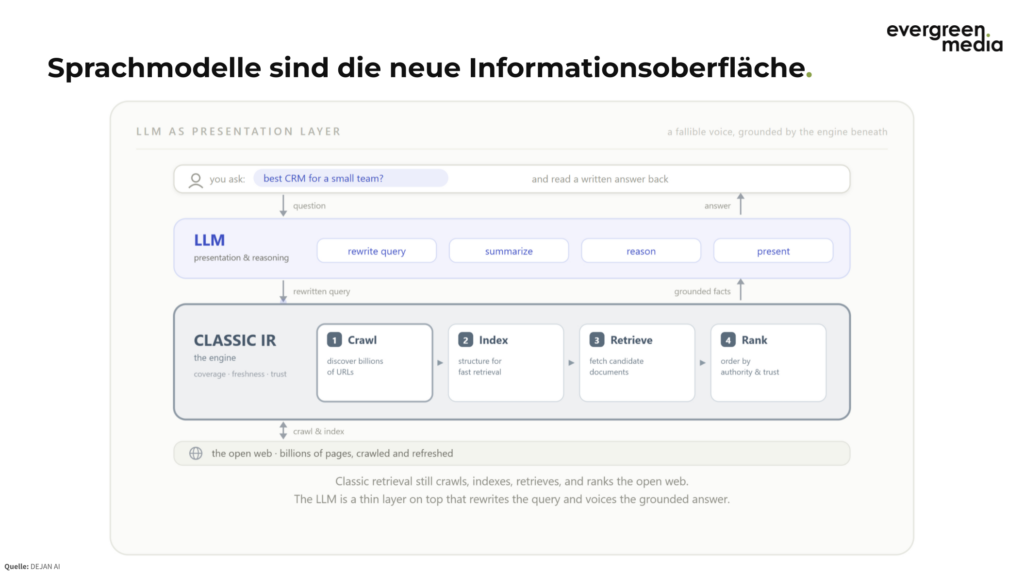
As strategist Tom Critchlow puts it, AI search isn’t about rankings, it’s about recommendations. If you don’t give a language model a reason to recommend your page, your product, or your brand, you get left behind.
The GEO Framework: Entity, Validation, Community
Think of the information spaces AI systems draw on as the three layers of a cake.
Entity Base
At the bottom sits entity. Official sources, the brand website, its Wikipedia page, official social profiles, and known directories, tell AI what a brand actually is, what it offers, for whom, and in what context. Without this base, nothing above it works.
Third-Party Validation
On top of that sits validation. Because brands control their own channels, AI needs independent confirmation: media coverage, trade publications, best-of lists, and comparison content. This is where real significance gets built. The more credible, independent sources describe a brand consistently, the more AI systems treat it as a reliable entity.
That lines up with the University of Toronto study mentioned earlier: it shows a clear, systematic preference for independent, authoritative sources over brand-owned and social media content, a notable contrast to the more balanced source mix in classic Google search results.
Community Voices
At the very top sits community: forums, Reddit, LinkedIn, social media. This signal reinforces relevance that already exists, but it can’t create it out of nothing.
AI visibility, then, is the result of a consistent digital presence built up over the long term.
What a brand says on social media has to match its website, and both have to match what the media reports. Contradictions lead AI systems to present conflicting views and recommend a brand less often, simply because they’re unsure what the entity actually is. And none of this is ever final: companies that work deliberately on the right signals today will be represented more accurately and more positively in future AI systems.
Why AI Visibility Is Every Department’s Job
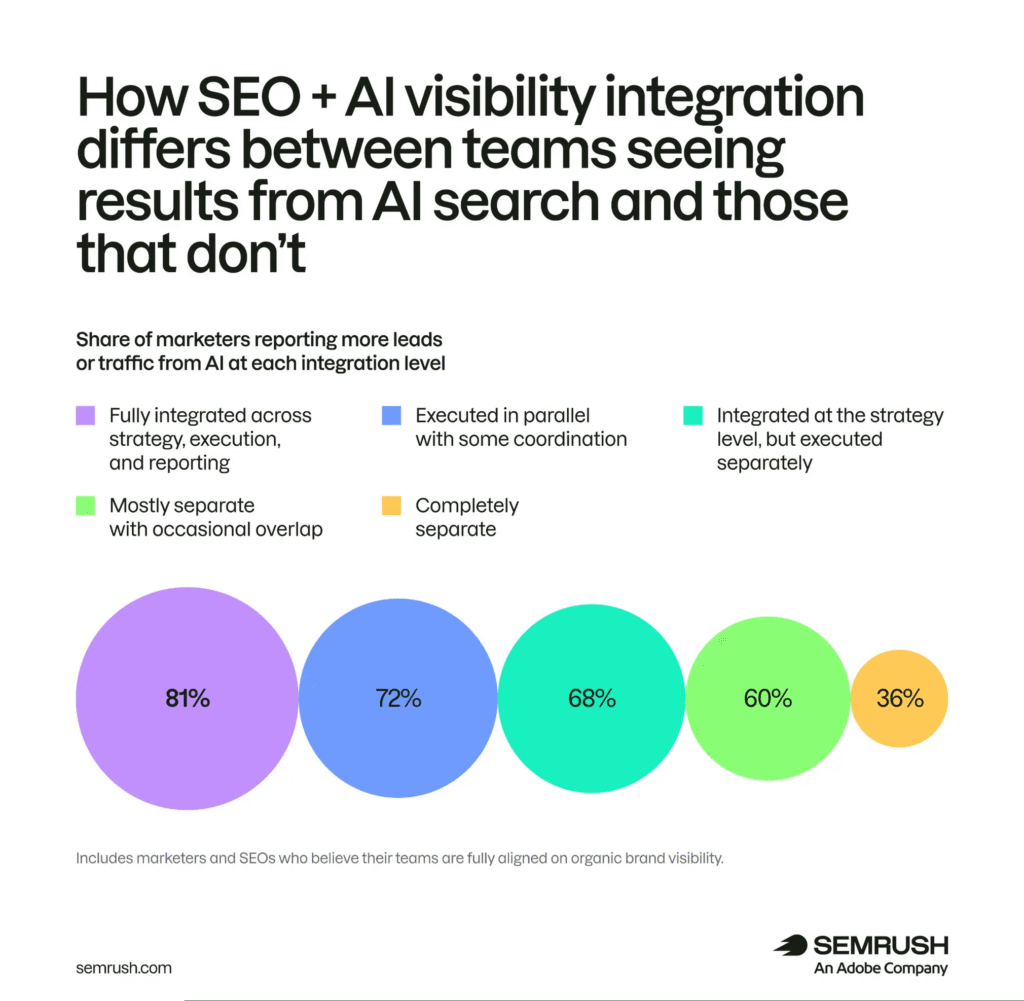
GEO is a cross-functional job. AI consumes and evaluates a brand’s overall digital footprint, not the output of one isolated department. A recent Semrush study on the operational gap between AI search and SEO backs that up with hard numbers: teams that run SEO and AI visibility as a fully integrated effort report more traffic or leads from AI platforms 81 percent of the time. Teams that keep the two completely separate see that in only 36 percent of cases.
Content supplies the information AI systems need. E-commerce makes sure conversion actually works. Data and performance teams measure what’s measurable. CRM and community teams shape a positive brand image through real customer interactions. Brand, PR and communications, sales, IT and web, product, and video each contribute their own signals, and together those signals add up to a brand’s digital footprint.
Video is one of AI’s preferred information sources, not so much because of the video itself. What matters are the context-rich transcripts behind it.
Companies that treat GEO as a pure SEO project give up exactly the levers that, according to the Semrush data, make the biggest difference.
Why AI Visibility Needs New Ways to Measure It
Classic SEO was precisely measurable: keyword ranking, click, landing page, conversion. That chain of cause and effect no longer holds for AI visibility, because every answer is personalized, and therefore unique. Even the leading provider in a given market wouldn’t show up in every AI conversation. Too much depends on individual variables.
What you can actually measure are mentions and citations across different models, and not much more. Comparing Claude and ChatGPT head-to-head is nearly impossible, since each draws on different sources and works differently under the hood.
Prompt tracking tools deliver valuable but incomplete data: they measure a single answer to a single prompt, logged out, using whatever country IP you choose, not the long, personalized conversations of logged-in users with their own history.
A skewed approximation of reality still beats no measurement at all. Companies that wait for perfect measurement to become possible wait too long and end up flying blind while competitors are already acting.
Solid measurement rests on six building blocks: clear scope and clear goals as the foundation, a rich data base, smart prompt design as the real centerpiece, clean categorization to organize the questions, a benchmark set of brands and competitors, and the often-overlooked layer of your own products and services.
On top of that, you need real customer data from sales and customer service, plus bot activity from server logs, since those are the only two genuinely solid dimensions besides prompt tracking itself.
Your Next Step
You can’t build AI visibility with a single trick or an isolated campaign. It comes from entity, validation, and community working together, coordinated across department lines. Companies that understand their own starting point today gain a genuine first-mover advantage.
Evergreen Media®’s AI Visibility Audit & GEO Roadmap delivers a structured analysis of your company’s AI visibility: Where does your company stand in ChatGPT, Gemini, and Google’s AI Mode? Which sources are driving that picture? What concrete steps will improve your AI visibility? Learn more now.



Comment