
Key Takeaways:
- AEO isn’t the same as SEO: Answer Engine Optimization focuses on being cited in AI-generated answers, not on ranking in traditional search results.
- Structured content wins: AI systems favor clearly structured, extractable content with concise answers and a logical flow.
- Trust is decisive: Strong E-E-A-T signals and authority increase the likelihood of being cited in AI answers.
- Platforms vary: ChatGPT, Google AI Overviews, and Perplexity have different preferences when selecting sources.
- Freshness is mandatory: Regular content updates are crucial. Brands leading in AEO update their content quarterly.
Answer engines, AI search, and AI assistants are reshaping the internet and fundamentally changing the rules of digital visibility.
While traditional search engines return links, ChatGPT, Google AI Overviews, and Perplexity deliver direct answers with only a handful of selected sources.
If you’re not being cited, you effectively don’t exist for a growing share of users—no matter how well your website is optimized for traditional search.
-
 Last updated: 12. February 2026Generative Engine Optimization (GEO) explained
 -
 Last updated: 12. February 2026Large Language Model Optimization (LLMO) explained
 -
 Last updated: 10. February 2026Understanding Google AI Mode: Overview & Functions
 -
 Last updated: 6. February 2026Google AI Overviews: What’s Changing for SEO & SEA in 2025
What is Answer Engine Optimization (AEO)?
Answer Engine Optimization (AEO) increases a brand’s visibility in AI-powered answer engines like ChatGPT, Perplexity, and Microsoft Copilot. Unlike traditional SEO, the goal isn’t to show up in search results—it’s to be cited as a source in AI-generated answers.
AEO is the logical evolution of SEO in an era where users increasingly expect immediately usable answers instead of doing long, manual research.
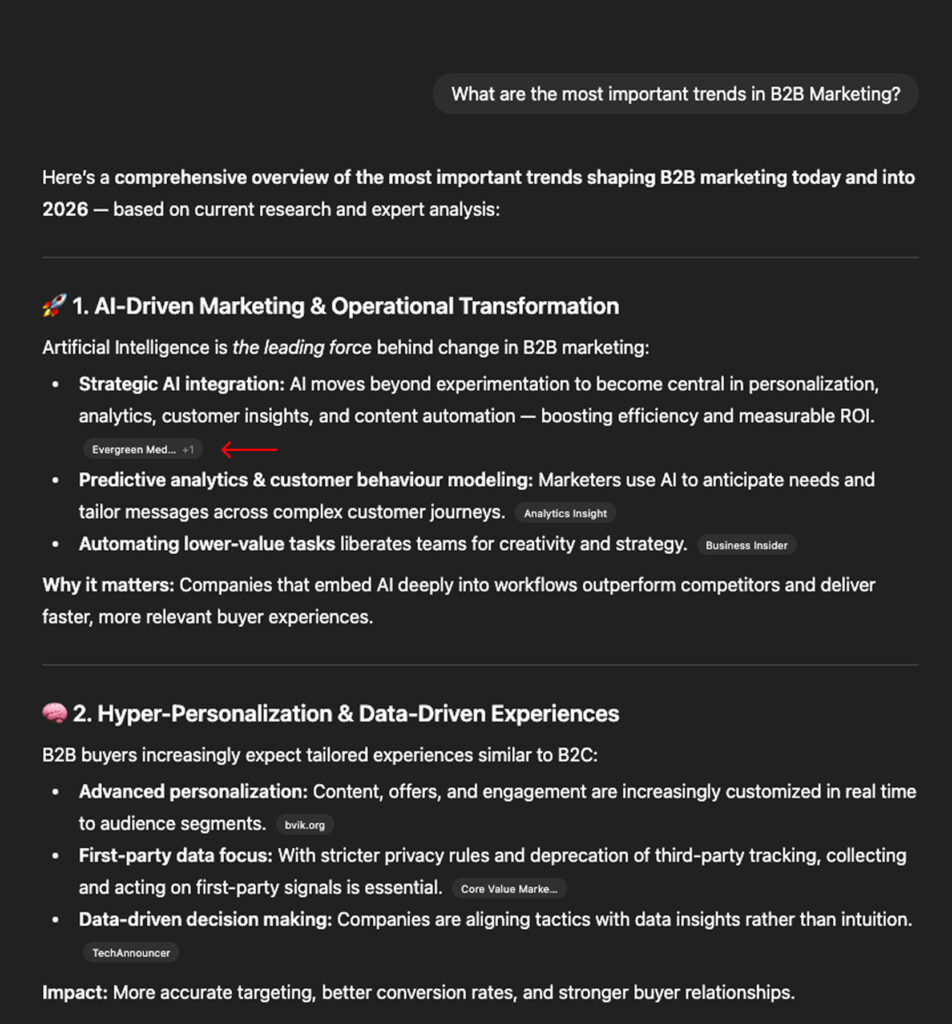
What are the most important AI platforms?
Based on our experience , the most important platforms for AEO right now are:
- ChatGPT (OpenAI): Over 700 million weekly users (Source: Nick Turley)
- Google AI Overviews: AI-generated summaries in Google search results
- Google AI Mode: Integrated into Google search (separate tab)
- Microsoft Copilot: Integrated into Windows and Office products
How many sources are typically cited per answer?
A comprehensive study by xfunnel.ai analyzed 40,000 AI answers from models like ChatGPT, Perplexity, and Gemini and reached the following average results:
- Perplexity: about 6.61 citations per answer
- Google Gemini: about 6.1 citations per answer
- ChatGPT: only 2.62 citations per answer
Why is AEO becoming more important for brands?
AEO is becoming increasingly important for companies because user search behavior is fundamentally changing. AI assistants are starting to accompany the customer journey and compress it.
- According to Forrester, 89% of B2B buyers have adopted generative AI as a central source for self-directed information throughout their entire buying process.
- ChatGPT now records 700 million weekly users and processes over 2.5 billion prompts daily according to Exploding Topics.
- At the same time, Google has rolled out Google AI Overviews and the ChatGPT-like AI Mode globally.
This shift means that brands and companies that don’t show up in AI answers will lose access to a growing share of potential customers.
Three key reasons AEO is gaining importance:
Changing user behavior: Instead of short queries, users ask complex questions like, “Which laptops under €1,500 are best for video editing and gaming, and also have long battery life?” And these aren’t one-off searches anymore. They’re context-rich conversations.
Declining click rates: AI answers reduce the need to click through to websites. A study from Pew Research Center shows that Google AI Overviews lead to significantly fewer clicks.
New touchpoints: AI platforms are becoming independent information channels that can influence the entire decision-making process.
What’s the difference between AEO, SEO, and Generative Engine Optimization (GEO)?
The lines between AEO, SEO, and GEO can be blurry. Still, here’s a clean way to separate the three:
Search Engine Optimization (SEO) focuses on ranking in traditional search engines. The goal is to win top positions in organic search results—measured through rankings, impressions, clicks, and traffic. The core levers are keywords, backlinks, and technical optimization.
Answer Engine Optimization (AEO) is narrower and focuses on the answer layer: content is structured so AI systems select it as the basis for specific answers, reproduce it correctly, and—where applicable—attribute it as a source. AEO targets the moment an answer is generated and focuses on how individual pieces of content are used in the response process.
Generative Engine Optimization (GEO) is the strategic and operational evolution of brand presence for AI-driven search. The goal is for a brand to show up—and be framed positively—in AI answers and summaries across the touchpoints and sources these systems pull from. GEO includes your owned content, the broader source ecosystem, and the measurement and management of AI visibility.
Surprising: Only 12% of URLs cited by LLMs also appear in Google’s top 10 results.
The study by Louise Linehan and Xibeijia Guan (based on 15,000 prompts with Ahrefs Brand Radar) showed:
- Overall, the overlap between AI citations and Google’s top 10 results is only 12%
- ChatGPT performs even worse with only 8% overlap with Google and Bing
- Perplexity shows the strongest proximity to traditional rankings (28% with Google, 14% with Bing)
- Across all platforms, the overlap with Bing is only 10%
- AI Overviews are the exception: here the overlap was 76% of cited URLs
These findings are notable because many assume systems like ChatGPT closely mirror Google search results. The study suggests that’s far less true than expected.
What are the biggest levers for AEO?
The most effective Answer Engine Optimization strategies start with understanding how AI systems process and prioritize information.
Content strategies for AI search can also help you package information in the way these systems prefer.
The following five levers have proven especially effective:
1. Structured, Extractable Content
AI systems prefer clearly structured content that can be easily extracted as answer building blocks. A study by SurferSEO shows that 40-61% of AI Overviews use lists or bullet points.
The inverted pyramid is key: start every section with the main point, then add supporting detail. Use semantically strong, question-style headings, and keep paragraphs to 25–40 words.
For maximum extractability, start informational pages with a short summary (like in this guide). It helps both time-constrained readers and AI systems quickly understand and classify the content.
In this video, we go deep on the topic:
2. Authority and E-E-A-T Signals
AI systems favor trustworthy sources. Strong E-E-A-T signals (Experience, Expertise, Authoritativeness, Trustworthiness) increase the likelihood of being cited in AI Overviews.
To demonstrate expertise, highlight authors with credible domain credentials, include quotes and references to authoritative sources, and build links and mentions from trusted websites. Publishing original research or data analyses is especially effective—it positions your brand as a true thought leader.
3. Semantic clarity and unambiguous wording
AEO favors precise, self-contained statements without ambiguity. The clearer and more direct your answers, the more likely they are to be cited. A sharp understanding of search intent also helps you deliver exactly the information users are looking for.
Compare these two examples:
- Not ideal: “In many cases, a VPN connection can be helpful for browsing the internet more securely.”
- Better: “A VPN encrypts your internet traffic and helps protect you from data theft on public Wi-Fi.”
The second sentence is clear and factual, without hedging language like “can” or “in many cases.” That kind of clarity makes it more valuable to AI systems.
4. Freshness and Regular Updates
AI platforms tend to favor up-to-date content.An analysis by AirOps shows that companies with high visibility in AI answers update content quarterly.
To signal freshness:
- implement lastModified attribute in schema markup,
- refresh core pages every 90 days, and
- add new stats and insights to existing content.
This matters most in fast-moving industries or topics where information changes quickly. A recurring content audit helps you identify outdated pages and keep your content current.
5. Originality and information gain
Duplicate content is yesterday’s problem. Today, it’s duplicate information. AI systems prefer content that adds real value—through original examples, data, frameworks, models, or unique perspectives.
To give your content a legitimate reason to exist, develop your own frameworks, share internal data or case studies, and offer angles that go beyond generic baseline knowledge.
Here’s an example:
- Not ideal: “Insulating a house is important to save energy.”
- Better: “Using the 20/80 insulation rule, homeowners can cut heating costs by up to 40% by optimally insulating the 20% of surfaces that matter most—like the roof and basement ceiling.”
The second version introduces a proprietary model, concrete numbers, and a fresh perspective. Exactly the kind of “information gain” AI systems value.
How do the ranking factors differ across AI platforms?
Different AI platforms use different methods to collect and prioritize information. Those differences require platform-specific optimization strategies.
ChatGPT and the “Wikipedia dominance”
ChatGPT shows a strong preference for established knowledge sources. According to Profound, Wikipedia alone accounts for 7.8% of all ChatGPT citations and dominates with 47.9% among the top 10 sources.
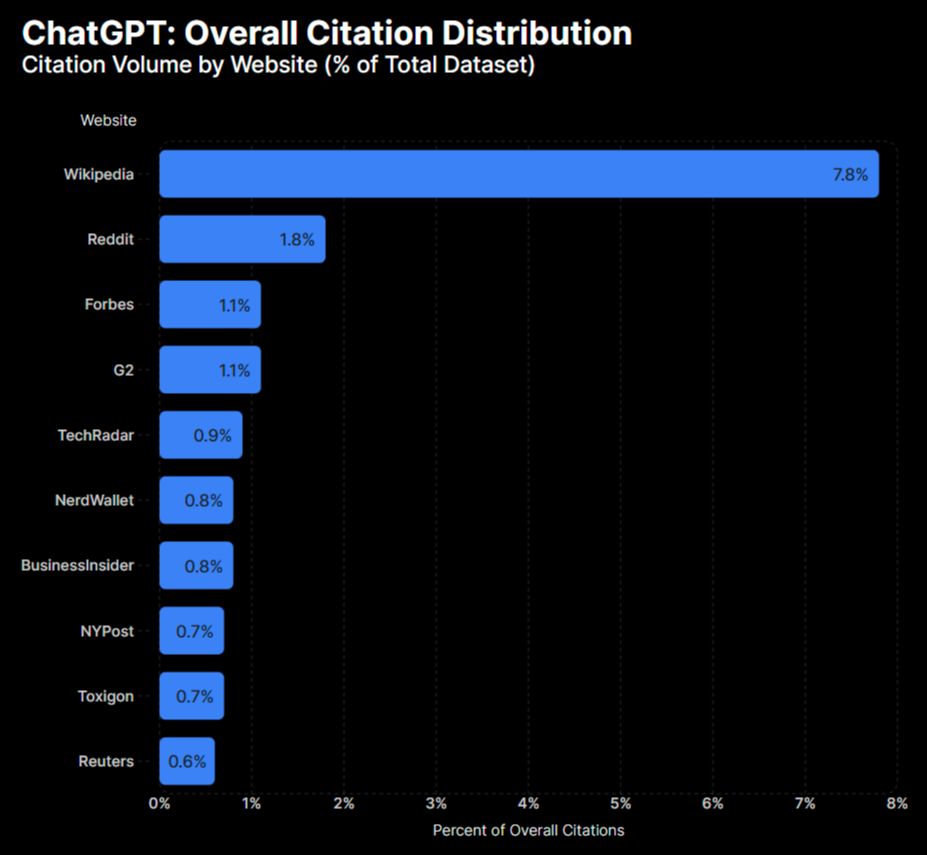
Current data from Profound also shows that citation patterns at ChatGPT have changed significantly. Referral traffic has declined by 52% since July 2024, while Reddit citations have increased by 87%. The top 3 domains (Wikipedia, Reddit, TechRadar) now control 22% of all citations.
This shift suggests ChatGPT increasingly prefers pages that deliver direct answers instead of referring to brand websites primarily focused on conversion.
Optimization Approaches for ChatGPT
- Provide direct answers: offer information, not sales arguments
- Build community presence: engage actively on Reddit and similar platforms
- Create comparative content: publish objective comparisons instead of pure brand messaging
Learn even more in this video:
Google AI Overviews and SERP integration
Google AI Overviews show a more balanced distribution of sources. The top 10 sources are spread more evenly, with Reddit leading at 21%.
For Google AI Overviews, classic SEO is still critical. Aim for top-10 rankings, structure content for extractability, and keep it fresh.
A key characteristic of Google AI Overviews is their tight coupling with the existing Google index meaning traditional SEO signals also increase the likelihood of being cited in AI Overviews.
Perplexity and community-first sourcing
Perplexity has a strong preference for community content. Reddit dominates with 46.7% of top-10 sources, followed by YouTube at 13.9%.
To gain visibility in Perplexity, build a Reddit presence, invest in video content, and engage on Quora and other Q&A platforms.
Perplexity’s focus on user-generated content highlights an important trend: AI systems increasingly treat the “wisdom of the crowd” as a trust signal.
The most effective approach is not just to be present on these platforms, but to deliver real value—through detailed, genuinely helpful answers that demonstrate expertise without sounding overly promotional.
What are AEO strategies for greater AI visibility?
An effective AEO framework is built around five core steps that should be implemented systematically. It works for companies of any size and can be adapted to industry-specific requirements.
Step 1: Analyze your current AI visibility
Start with a baseline assessment of your current presence in AI answers. Identify which topics and questions already trigger citations of your brand and where the gaps are.
This requires a systematic approach:
- Collect relevant questions from your industry, test them across multiple AI platforms, and document which sources get cited and why.
- Analyze the structure and content of the winning sources to identify patterns.
It’s especially useful to map your audience’s customer journey and anticipate the questions asked at each stage, from awareness through decision.
Step 2: Optimize content for extractability
Improve existing content and create new content designed specifically for AI extraction. The focus is on clear answers, logical structure, and semantic precision.
Use the inverted pyramid consistently: every section starts with the key takeaway, followed by supporting detail. Turn headings into questions (“What…?”, “How…?”, “Why…?”) to sharpen semantic clarity. Structured elements like lists, tables, and short paragraphs increase extractability.
Step 3: Build authority and trust signals
Position your brand as a credible source of information. AI systems tend to favor sources with strong E-E-A-T signals (Experience, Expertise, Authoritativeness, Trustworthiness).
How to build digital authority:
- Publish expert content with detailed author bios and relevant credentials.
- Produce original studies or data analyses to demonstrate domain expertise.
- Build a backlink profile with high-quality links from authoritative sites.
- Maintain an active presence on expert platforms like LinkedIn and industry forums.
Step 4: Distribution and cross-channel presence
Distribute your content across multiple channels to increase the likelihood it’s discovered and ingested by AI systems. A multi-platform strategy maximizes exposure.
How to expand your digital footprint:
- Repurpose content for different platforms.
- Build an active community presence where your audience is already talking.
- Use PR to earn mentions in established media and ensure your facts and messaging stay consistent across channels.
It’s especially important to show up on platforms AI systems often favor ike Reddit, Quora, YouTube, and specialized forums. Your presence needs to be authentic and genuinely helpful, not just a stream of marketing messages.
Step 5: Measurement and iteration
Regularly monitor your AI visibility with tools like Peec AI or Profound and adjust your strategy accordingly. AEO is a continuous process requiring constant optimization.
How to measure success in AI search and chatbots:
- Model your customers’ buyer journey as a set of prompts and measure share of voice across that journey.
- Track referral traffic and revenue from AI platforms by setting up custom channel groups in GA4.
- Analyze which content performs well, identify patterns, and replicate them.
Your next steps to increase AI visibility
AI assistants and AI search engines are changing the rules. Companies that act now can secure critical visibility in AI-driven search across the entire customer journey. AEO isn’t a short-term trend. It’s the logical evolution of SEO.
If you want to position your brand for an AI-first future, a structured approach pays off:
- Assess your baseline: Where are you already showing up in AI answers today?
- Rethink content: Package information so it’s extractable, unambiguous, and citation-ready.
- Build authority: Strengthen expertise signals, publish original research, and create clear trust cues.
That’s exactly how we support companies like yours—as a strategic sparring partner bridging traditional SEO, content strategy, GEO, digital PR, and AI-driven growth.
Book an intro call and let’s build the foundation so your brand shows up not just in search engines, but in the answers that will shape tomorrow.




Comment