
Key Takeaways:
- GEO makes brands visible in AI-generated answers – for example in ChatGPT, Perplexity, Google AI Mode, or Google Gemini.
- GEO ≠ SEO: GEO is a new layer on top of traditional SEO – content shouldn’t just rank, it needs to be cited by large language models.
- Three engine types: Training-based, search-based, and hybrid models – each type requires different strategies.
- Market shift: the share of generative answers is rising fast—brands that act early lock in new touchpoints in digital marketing.
Are you wondering how to make your brand visible in a world where AI models like ChatGPT, Perplexity, and Google Gemini are setting the pace? Or are you trying to figure out whether these technologies are actually relevant for you?
In this guide, you’ll learn what Generative Engine Optimization (GEO) really means, understand the different types of AI engines, and get practical guidance on whether—and how—you should engage with the topic.
-
 Last updated: 10. February 2026SEO Trends 2026: Developing Strategies for the AI Era
 -
 Last updated: 10. February 2026Understanding Google AI Mode: Overview & Functions
 -
 Last updated: 6. February 2026ChatGPT Search (SearchGPT) Optimization: The Guide
 -
 Last updated: 12. February 2026Large Language Model Optimization (LLMO) explained
 -
 Last updated: 12. February 2026Answer Engine Optimization (AEO): AI visibility in 2026
What are Generative AI Engines?
Generative AI engines (also called generative engines or generative AI systems) are systems built on large language models (LLMs) that can generate language output on their own based on user input (prompts)—including answers, written content, recommendations, or solutions to problems.
These systems have been trained on billions of pieces of text from the internet, expert sources, and structured data. They process natural language, recognize semantic relationships, and dynamically combine information to produce context-aware outputs.
Examples: ChatGPT (OpenAI), Google Gemini, Claude (Anthropic), Perplexity, Meta LLaMA.
Example Outputs from Generative Engines
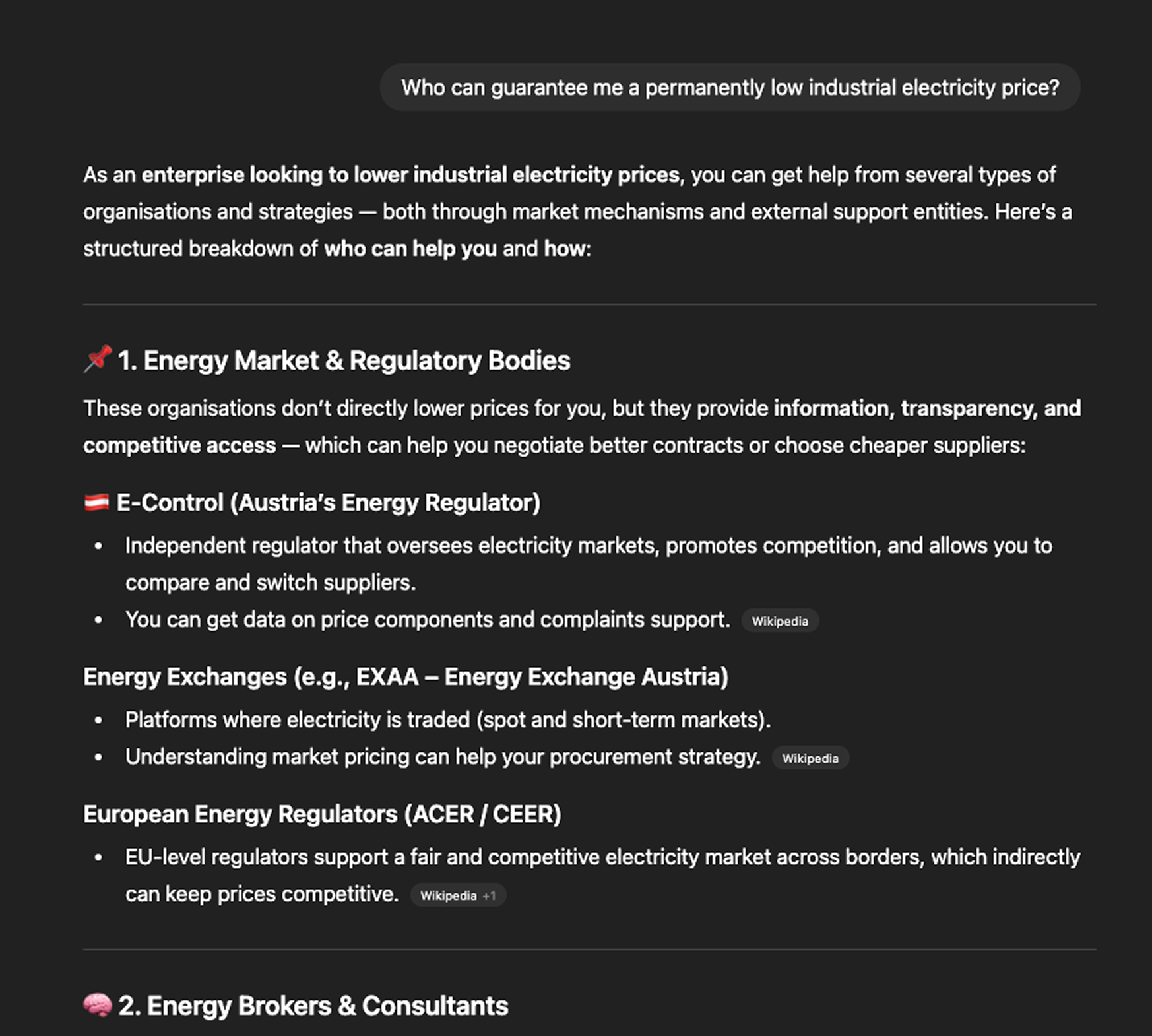
A sample ChatGPT response from the B2B energy sector:
“Who can guarantee me a permanently low industrial electricity price?”
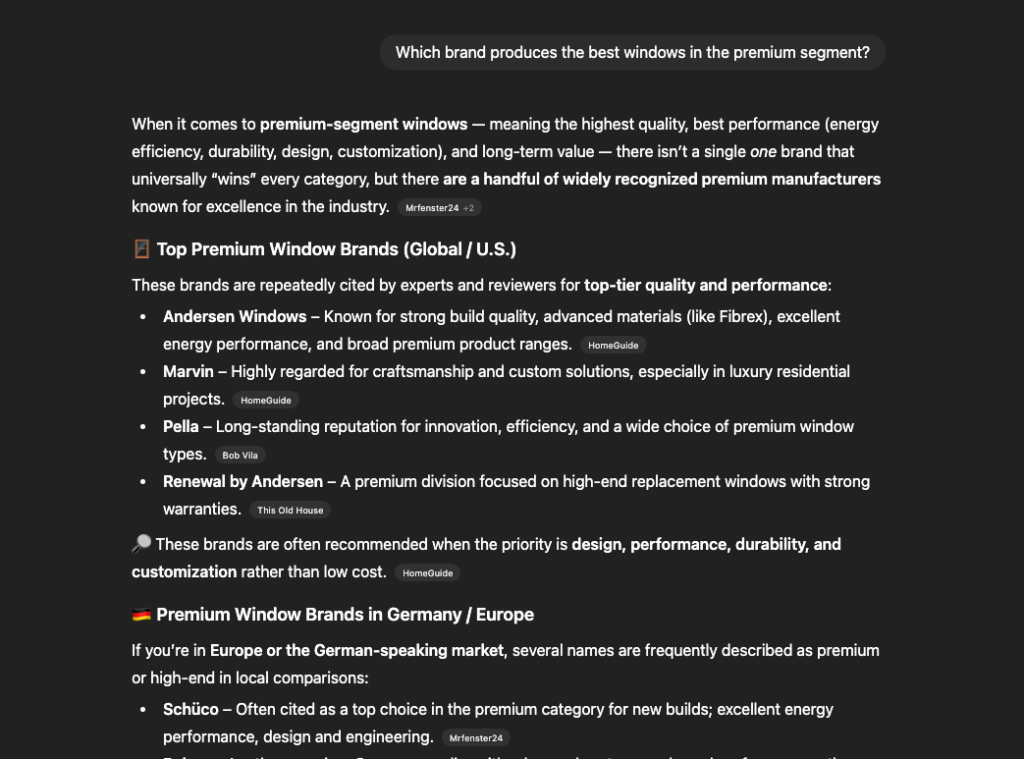
A sample Gemini response from the B2C energy sector:
“Which brand produces the best windows in the premium segment?”
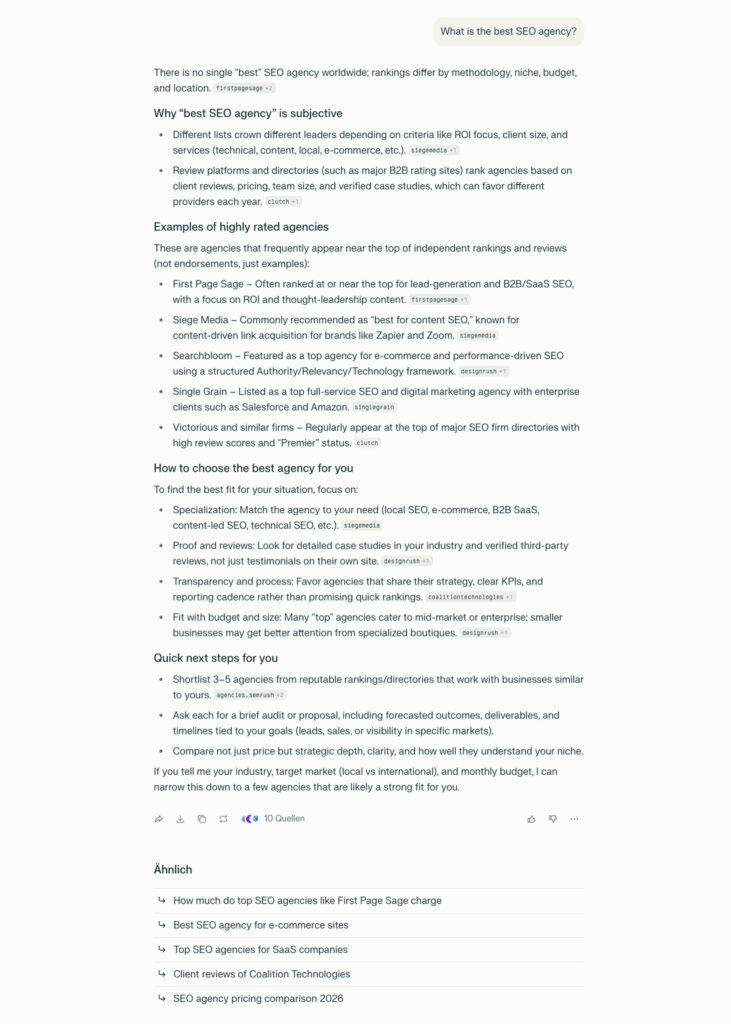
A sample Perplexity response from the B2B services sector:
“What is the best SEO agency?”
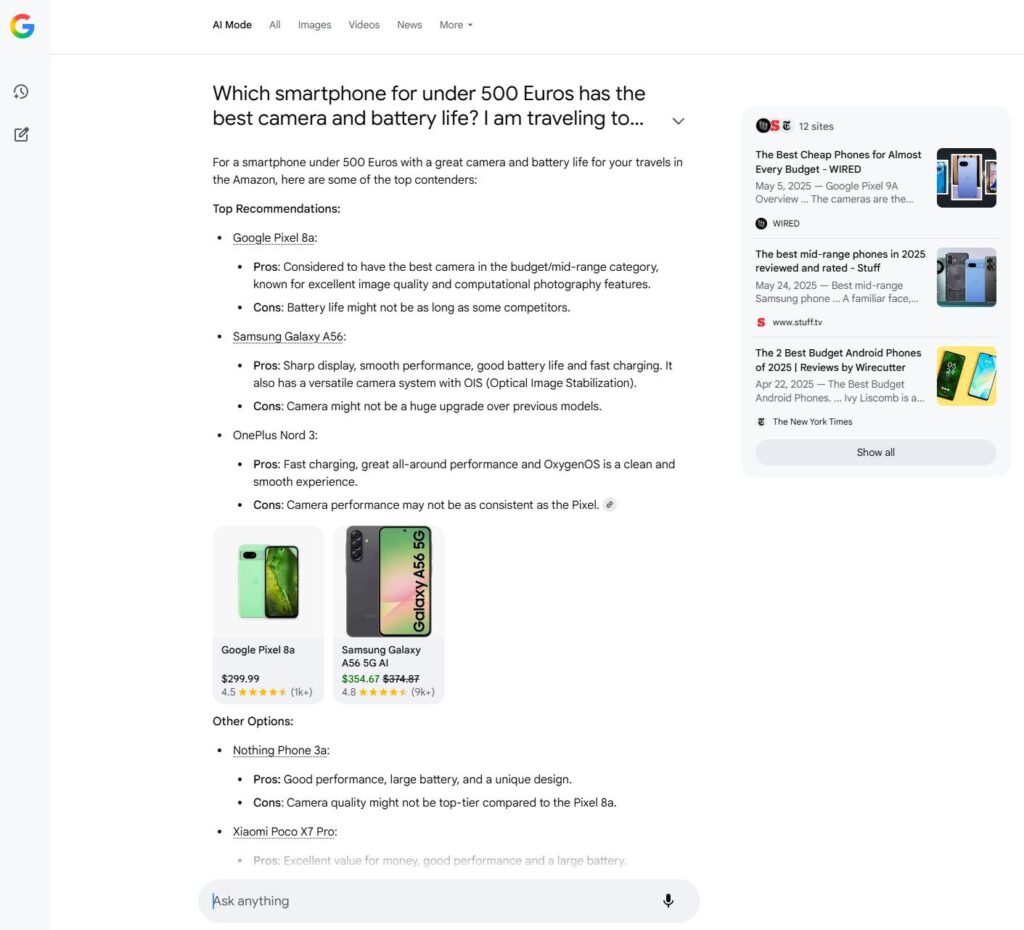
A sample response in Google AI Mode from the B2C space:
The Three Types of Generative AI Engines
What types of generative AI engines are there?
Training-Based Systems (e.g., Claude, Llama)
These models rely purely on what they learned during training.
Can you influence them? Only through long-term efforts like digital PR and building a broader digital footprint.
Search-Based Systems (e.g., Google AI Overviews, AI Mode, Perplexity)
These engines pull from real-time web indexing.
Here, classic SEO matters a lot: make sure your content is among the sources these engines choose to reference.
Hybrid Systems (e.g., Google Gemini, ChatGPT Search)
These combine training data with live web content.
For example: foundational knowledge comes from the model, while up-to-date recommendations come from the web.
What is Generative Engine Optimization (GEO)?
Generative Engine Optimization (GEO)—also called GenAI Engine Optimization—is the strategic process of shaping content, brand presence, and digital assets so they’re more likely to be processed, cited, or directly incorporated by generative AI systems like ChatGPT, Perplexity, or Google Gemini.
The goal of GEO is to make companies, brands, products, services, or content visible in these systems’ outputs—whether through:
- being mentioned as a brand or solution in answers,
- being linked or quoted in systems with web access,
- being (invisibly) pulled during an AI’s background research, or
- being integrated into training data over time through a stable presence on high-quality platforms.
GEO Tactics
GEO goes beyond traditional SEO because it’s not just about showing up in search results—it’s about becoming part of the answer logic of AI systems.
Core GEO tactics include:
- Publishing context-rich, well-structured, and genuinely original information on trusted sources.
- Building presence on platforms that actively feed into LLM training (e.g., Wikipedia, Reddit, top-tier media).
- Strengthening authority through strategic PR, data leadership, and thought leadership.
- Technical and semantic optimization to make content easily machine-readable and extractable.
LLM + RAG = More accurate and trustworthy
Large Language models like ChatGPT or Google Gemini sometimes deliver precise answers and sometimes confusing or flat-out wrong information.
That’s because they don’t understand content the way humans do. Instead, they analyze statistical relationships between words.
There’s a solution for that:
What is Retrieval-Augmented Generation (RAG)?
RAG improves the quality of AI answers by pulling in external sources. This lets the model combine what it “knows” from training with up-to-date information from the web.
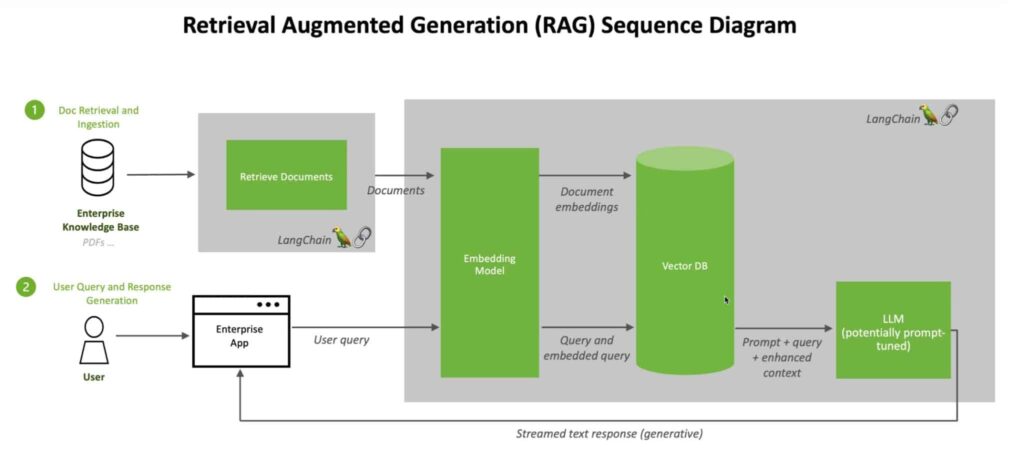
Benefits of RAG:
- Access to current, reliable facts
- Transparency: users can see the sources behind an answer
- Less need to constantly retrain the model—resulting in more dependable outputs overall
What RAG Means for You
Systems like ChatGPT and Google Gemini (when they have internet access) use RAG to pull fresh content from search indexes.
Here’s how it works:
- Internal knowledge: the LLM uses what it learned during training. You can influence this only indirectly, and usually not in the short term.
- External sources: current web content is added. This is where SEO can increase your visibility.
The result is a curated answer built from relevant facts and sources.
Which search indexes do different generative engines use?
- ChatGPT = Bing
- Gemini = Google
- Perplexity has its own index
What we learned from the Claude leak (update: May 22, 2025)
The leaked Claude system prompt showed—in unusual detail—when a language model like Claude actually pulls in external content, and when it doesn’t.
By default, Claude answers from its internal model knowledge without triggering a web search. It only “looks things up” when information is time-sensitive, multi-perspective, or outside the training corpus and only then is there any real chance of a source citation.
That means:
If you publish content on stable, “encyclopedic” topics, you usually won’t get traffic because the model can answer internally and doesn’t cite sources.
Visibility only happens where the model genuinely needs external content. So the key is to show up in the categories that force retrieval, especially “single_search” (current facts) or “research” (complex tasks). That’s where the model is most likely to search, cite, and link out. Content doesn’t just need to be accurate and high quality. It needs to be structured, current, or irreplaceable enough that the model can’t avoid referencing it.
What this means for GEO: Your content has to be specific or up-to-date in a way the model can’t answer from memory. Think interactive tools, current market comparisons, frequently updated price lists, original study results, or firsthand experience reports. Only then will your content get searched, mentioned, or linked.
Does generative AI change search traffic?
A lot of people think tools like ChatGPT and Perplexity will replace traditional search engines. In reality, generative AI doesn’t change demand. It changes the path to the answer. Buyers reach outcomes faster: fewer clicks, fewer touchpoints, but the same number of potential conversions.
Here’s why I believe that’s what’s happening:
Traditional search queries were mostly simple, direct, and low-context which is why 97%+ of traffic on most websites never converted.
But AI tools like ChatGPT, Google Gemini, AI Overviews, Copilot, and Perplexity unlock an entirely new class of more complex questions. Questions that used to be hard or impossible to answer well.
Instead of searching “best laptops 2025,” people now ask generative engines:
“Which laptops under €1,500 are best for video editing, gaming, and have long battery life?“
With AI-powered chatbots and search experiences, you can get a genuinely useful answer curated from many sources.
Generative AI will replace simple, generic searches, but those were rarely high-converting anyway. The real question isn’t what disappears, but which intents are actually valuable for companies.
Years ago, we already advised clients to focus further down the marketing funnel because that’s where revenue is generated, and everything else can be “eaten” by AI.
According to Gartner, search volume via traditional search engines would drop by 25% by 2026. Generative AI would become an answer engine and force companies to rethink their channel strategy.
Organic and paid search are vital channels for tech marketers seeking to reach awareness and demand generation goals. Generative AI (GenAI) solutions are becoming substitute answer engines, replacing user queries that previously may have been executed in traditional search engines. This will force companies to rethink their marketing channels strategy as GenAI becomes more embedded across all aspects of the enterprise.
That prediction ended up coming true a bit… differently.
Search volume has increased. People are searching more on Google. And ChatGPT isn’t replacing Google. It’s generating additional queries (source: Semrush).
But clicks are dropping sharply.
Recent studies—like Ahrefs—already show a significant decline in clicks due to AI Overviews. With Google AI Mode, a conversational search experience, that trend is likely to accelerate. The new mode was fully rolled out in the U.S. as a separate tab in May 2025. Since early October 2025, AI Mode has also been available in Europe.
Consumers and B2B buyers too now suddenly have an AI assistant through ChatGPT, Copilot, and AI Mode: a “advisor” that guides them quickly through the purchase journey. Clicks are no longer the metric, because these platforms aren’t designed around sending traffic. They influence decisions but they rarely send a click.
Is attribution dead? Partly—honestly, yes.
People go directly to the website, Google the brand or product name, or walk into a physical store. Attribution gets hard. But the channel is unavoidable, as this recent McKinsey study shows:
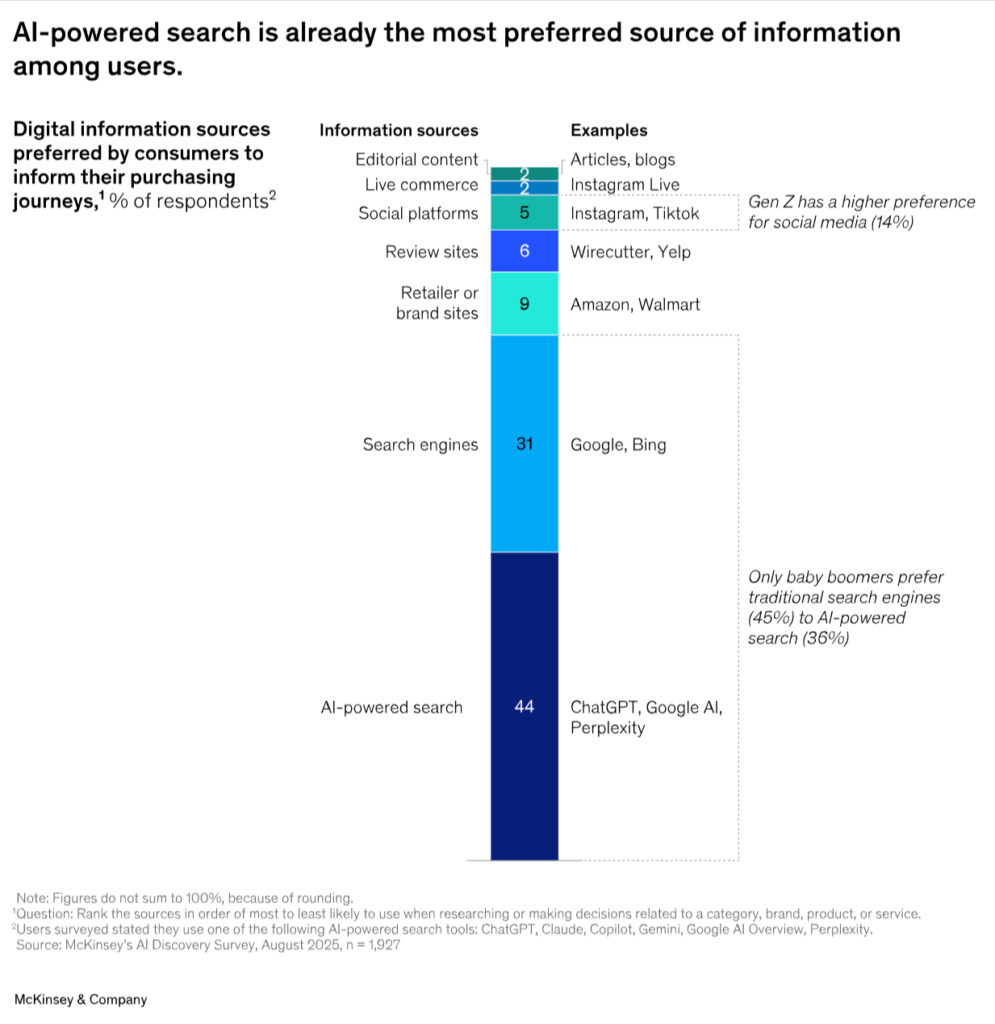
Companies and marketing teams will have to learn that clicks and traffic aren’t valuable marketing KPIs. For most business models, they never really were. With AI search, purchase decisions are increasingly made before people ever land on your website. That requires a fundamental rethink.
We’re still relatively early in this paradigm shift. Even so, we recommend that our clients thoroughly assess the potential in their industry—independent of traffic potential. More on that at the end of the guide.
Our take:
- Generative AI changes how people search, not whether they search.
- Classic short-form queries (e.g., “best laptops”) decline, while more complex search dialogues emerge.
- Total search activity increases, but the behavior changes: faster, more conversational, often with no click.
- Visibility shifts to the answer surface—not the website, but the model. If you want to stay relevant, you have to show up in these new answer environments.
Should you optimize your brand for generative engines?
Yes. We’re still early but this technology is already relevant today:
- Google AI Mode is live in 200+ countries, including across Europe.
- ChatGPT sees over 3.8 billion visits per month (source: Similarweb).
- In other words: generative engines are gaining importance fast.
Our recommendation for budget allocation:
- If your SEO strategy is already strong, invest an additional 20–25% of your SEO budget into GEO.
- If your SEO still needs work, prioritize SEO first. GEO builds on those fundamentals.
According to a recent analysis by Seer Interactive, there’s a strong correlation (~0.65) between a brand’s page-one Google rankings and being mentioned by LLMs (disclaimer: correlation doesn’t imply causation).
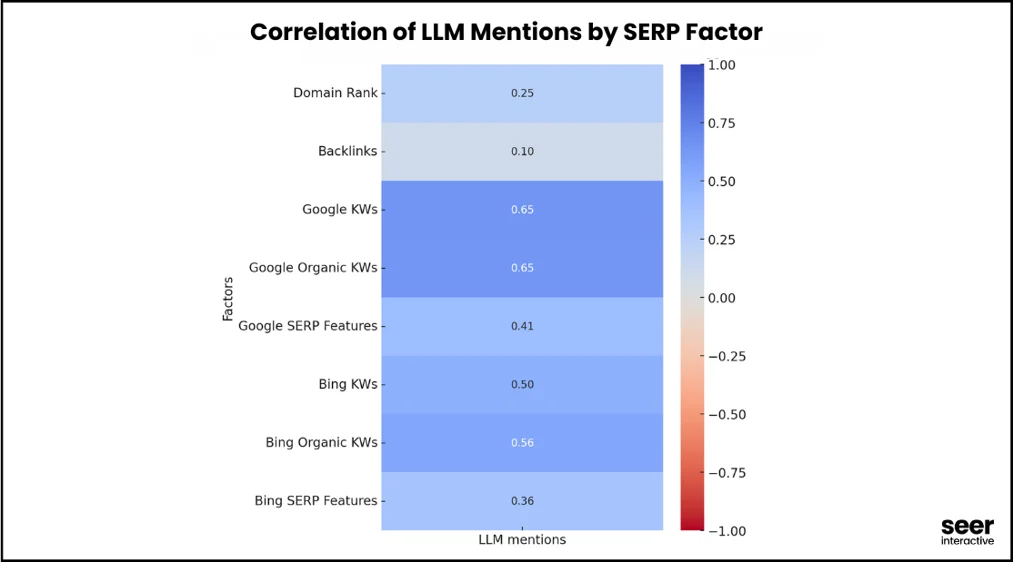
Generative engines won’t make SEO, content marketing, or digital PR obsolete. If anything, those disciplines remain the foundation for winning visibility on these AI platforms.
My personal take
Generative engines are simply a better interface for accessing information.
Old-school search pushed us to make everything as generic as possible—to be everything for everyone. That was never great. The new systems will revolve around delivering the right information to the right audience at the right moment.
How can you optimize your brand for generative engines?
1. What gets cited in your niche?
The first step is a detailed analysis of AI citations and brand mentions in your industry. The goal is to understand where, how, and why certain brands get surfaced in answers from systems like ChatGPT, Perplexity, or Google Gemini.
Approach:
- Industry & topic analysis: define relevant topics, questions, and objections across the customer journey.
- Identify key players: analyze important influencers, sources, and competitors.
- Winning content formats: review which content types achieve high citation rates.
- Pattern recognition: identify the factors that increase visibility in AI answers.
- Recommendations: derive actionable, high-impact steps.
You can run this kind of AI visibility audit yourself or book it with us.
2. Why are those pieces of content cited?
In this video, you’ll learn what generative search engines cite and why:
3. How can your brand get cited more often?
Most GEO tactics fall into three buckets:
- Content optimization: e.g., answer format and relevance, stronger page structure.
- Structural improvements: e.g., better site architecture, more intentional content segmentation.
- External levers: e.g., digital PR, leveraging knowledge platforms and aggregators, expanding your digital footprint.
In this video, I’ll show you how to optimize content for AI Overviews and how to increase the chances your website gets cited. The recommendations also apply to other generative engines.
Don’t assume that basic SEO tactics and content tweaks are enough. This quote from Tom Critchlow captures the paradigm shift best:
The future of AI-search isn’t about rankings, it’s about recommendations. I think all of the talk about vector embeddings and passage indexation misses the forest for the trees.
Indexation and so on will continue to be important but if you’re not giving the LLM a reason to recommend your page/product/brand then you’re going to get left behind.




Comment