Everything About Google AI Mode in 10 Seconds:
- Google AI Mode is available in 200 countries, including Austria, Germany, and Switzerland
- Google brings ChatGPT-like search with Gemini 2.5 technology
- Deep Search mode conducts hundreds of searches in parallel and delivers cited, summarized results
- Thanks to Project Astra, Google now answers questions in real-time about what the smartphone camera sees
- Agentic Search is coming. Soon Google AI Mode can make purchases independently
- AI Mode offers price comparisons, virtual try-ons, and automated checkout
- Search results can be tailored to individual interests, Gmail content, and previous searches
- Ads are already active in AI Overviews and will soon roll out in AI Mode too
The search engine as we know it is dying – and Google itself is pulling the plug.
With AI Mode, the search giant is transforming its most important revenue source into a personalized AI cockpit that completely ewrites the rules of digital marketing.
No longer will keywords or rankings determine your success, but how well your brand performs in a world where every user receives unique, tailored answers.
-
 Last updated: 6. February 2026LLMO, GEO & SEO Costs: Budgets + Distribution for AI Search
 -
 Last updated: 6. February 2026Google AI Overviews: What’s Changing for SEO & SEA in 2025
 -
 Last updated: 6. February 2026ChatGPT Search (SearchGPT) Optimization: The Guide
 -
 Last updated: 10. February 2026SEO Trends 2026: Developing Strategies for the AI Era
What Is Google AI Mode?
Google AI Mode is an advanced AI-powered search function that goes beyond traditional search results. Unlike the already familiar AI Overviews, AI Mode appears as a separate tab next to regular search and uses Gemini 2.5, Google’s most powerful AI model, to answer complex questions.
AI Mode was initially introduced as an experiment in Google Search Labs in March 2025 and has been available to all US users since May 2025. Since October 7, 2025, AI Mode can also be used in Germany, Austria and Switzerland.
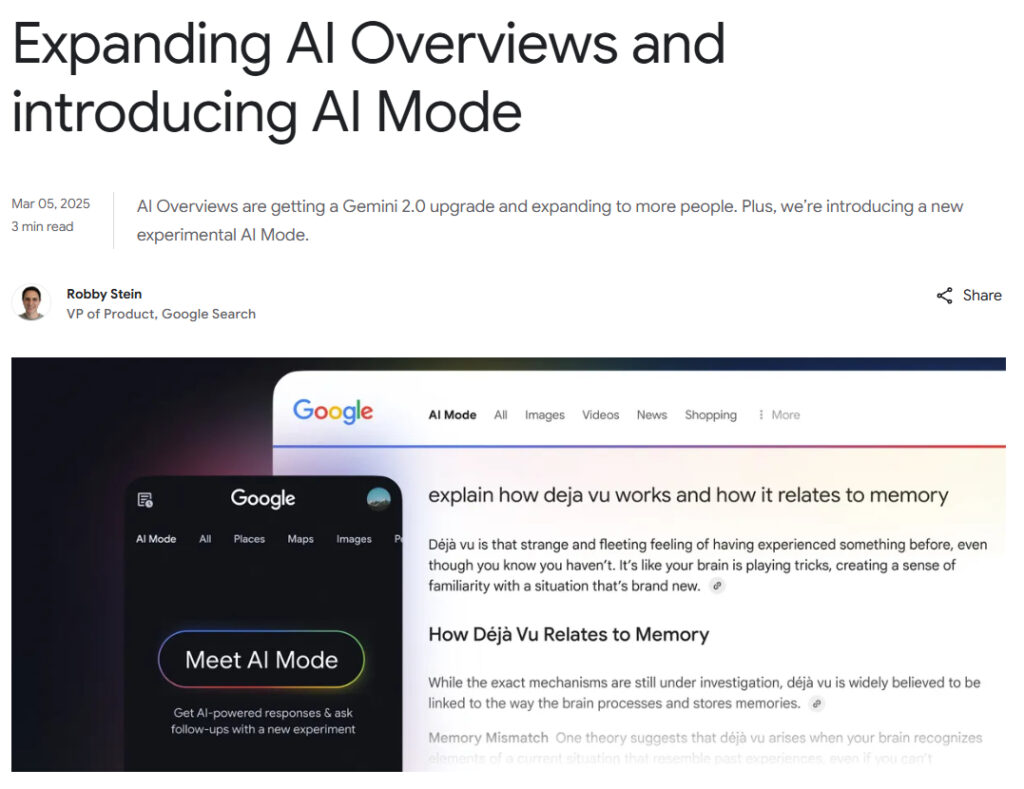
The core function of AI Mode is the so-called “Query Fan-out” technique (it was also already used for AI Overviews).
Instead of a single search, Google simultaneously conducts numerous sub-searches, analyzes the results, and summarizes them into a comprehensive answer.
- More comprehensive answers: AI Mode delivers more complete information than traditional search results
- Conversation-based: Users can ask follow-up questions and conduct a dialogue
- Personalized results: Each user receives individual answers based on their data
- Multimodal functions: Supports text input, voice, and image analysis
Google AI Mode in numbers:
According to Google CEO Sundar Pichai, search queries in AI Mode are on average 2-3 times longer than traditional Google searches—sometimes even 5 times as long.
What Does AI Mode Look Like?
Here’s the official promotional video from Google:
For example, this is what the output looks like for an informational search query:

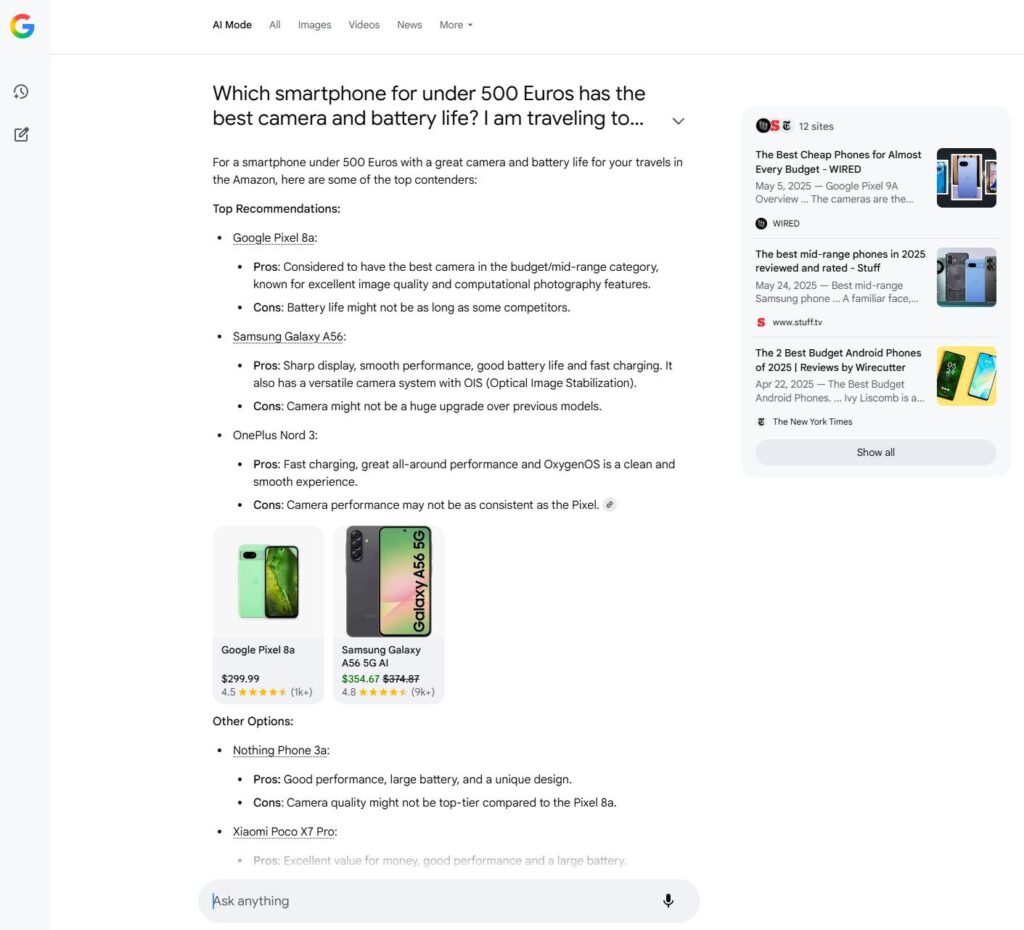
Here’s an example of a very specific product search:
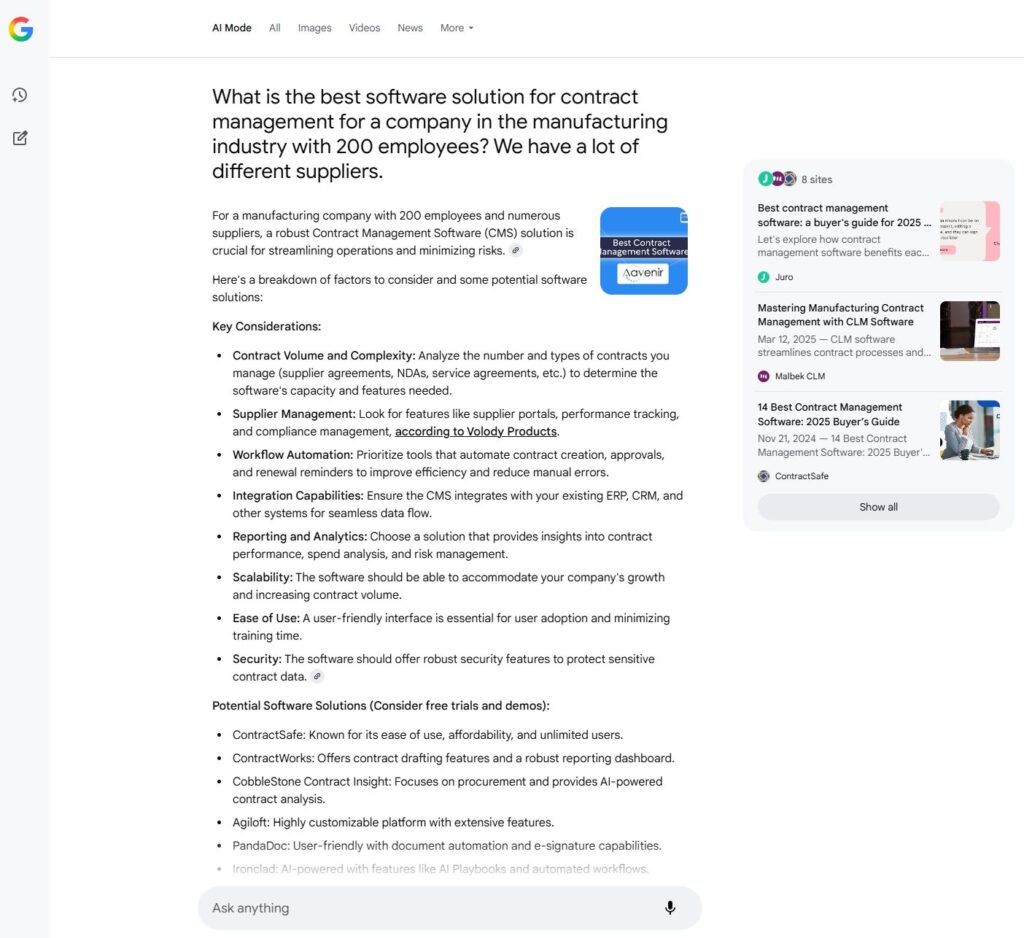
And this would be an example of a commercial B2B search:
How Does Google AI Mode Work?
Google AI Mode doesn’t just understand what someone is searching for, but also exactly what’s meant—based on context like location, behavior, or previous queries. It independently collects additional information, analyzes suitable content from the web, and creates a direct answer instead of just showing links (patent).
Let’s look at the process step by step:
1. Query Input (Multimodal)
Users enter their question via text, voice, or image. This input is analyzed by the system and matched with possible related search intents.
2. Context Is Included
Google uses user signals like location, device, previous search queries, Gmail or Maps data – everything that helps better understand the question.
3. Initial Interpretation by the Language Model
The language model (e.g., Gemini 2.5) analyzes the query and derives what intention lies behind it – such as: Does the person want to buy, compare, or just gather information?
4. Generation of Parallel Search Queries (Query Fan-Out)
The AI independently creates several supplementary search queries to gather additional information – also based on user context.
5. Documents Are Retrieved from the Index
Google retrieves suitable content from the web – not just for the main query, but for all generated secondary queries.
6. Query Is Classified
The search query is categorized: Is it informational, transactional, comparative? This determines what the answer should look like.
7. Specialized Language Models Generate the Answer
Depending on classification, specialized AI models come into play – such as for extraction, summarization, or decision support.
8. The Final Answer Is Created
The AI’s answer is compiled from various sources and content—and formulated in natural language.
9. Display in the Frontend
The finished answer is displayed in the Google interface – often with references to individual sources. A click to your website is possible but not guaranteed.
My Assessment as Video from June 4, 2025
I share my assessment on the future of search and the changes coming for all of us in this video:
How Do AI Mode and AI Overviews Differ?
AI Overviews and AI Mode are two different implementations of Google’s AI technology in search:
- AI Overviews: Appear directly in regular search results above organic hits and summarize information
- AI Mode: A separate search experience with its own tab that enables deeper, conversation-based interactions
The most important differences at a glance:
| Feature | AI Overviews | AI Mode |
| Integration | Part of regular search results | Separate tab/mode |
| Depth | Summary from few sources | In-depth analysis from hundreds of sources |
| Interaction | Limited follow-up questions possible | Complete dialogue with context understanding |
| KI-Modell | Adapted Gemini model | Full version of Gemini 2.5 |
| Functionality | Mainly text-based answers | Multimodal functions, Deep Search, visualizations |
| User Control | Automatically displayed | Conscious user choice through tab switch |
| Personalization | Limited | Comprehensive with Google account data |
How Does AI Mode Differ from ChatGPT?
Orientation
ChatGPT: An AI-powered chatbot based on the GPT-4 model, designed for text generation, answering questions, and creative tasks.
Google AI Mode: A new feature in Google Search based on the Gemini model, aimed at improving search queries through AI-generated, context-related answers.
Data Access & Personalization
ChatGPT: Has limited access to current web data and starts without specific user information. Personalization occurs over time through interactions.
Google AI Mode: Can, with user consent, access personal data from Gmail, Google Drive, YouTube history, and other Google services to immediately deliver personalized answers.
Functions & Integration
ChatGPT: Offers functions like text generation, code creation, image generation (with DALL·E), and data analysis. Integration with various tools via plugins is possible.
Google AI Mode: Integrated into Google Search and offers AI-generated answers directly in search results. Uses the Gemini model for multimodal inputs, including text, images, and voice.
Multimodality
ChatGPT: Mainly supports text and image processing. Voice and video processing are limited.
Google AI Mode: Offers comprehensive multimodal capabilities, including text, image, audio, and video processing, enabling more versatile interaction.
What Core Functions Does AI Mode Offer?
1. Deep Search
Deep Search is the most advanced research function in AI Mode. It can execute hundreds of search queries simultaneously, analyze the results, and create a comprehensive, fully cited report. For complex research that would normally take hours, Deep Search delivers well-founded answers within minutes.
- Time savings: Complex research in minutes instead of hours
- Complete source citations: Every piece of information is verifiably documented
- Thematic depth: Coverage of different perspectives and aspects
- Structured presentation: Clear organization of complex information
2. Agentic Tasks
AI Mode can actively take over tasks for the user—a function Google has developed under the project name „Mariner” These agentic functions – tasks the AI performs independently for the user—take over annoying routine tasks and save time.
Instead of just providing information, AI Mode can, for example, actively search for the best ticket offers for an event, compare prices, and prepare the purchase process. It can suggest restaurant reservations based on preferences and availability or coordinate appointments for local services.
Google works with partners like Ticketmaster, StubHub, Resy and Vagaro to enable this seamless integration.
3. Personalized Recommendations
With user permission, AI Mode can access personal data from the Google account to deliver tailored answers. This 1:1 personalization makes every search experience unique and dramatically increases the relevance of results.
AI Mode can, for example, consider appointments from your calendar when you search for restaurants, or recognize travel plans from your Gmail confirmations to provide suitable local recommendations. It can even derive preferences from your previous search behavior to suggest more relevant products or services.
4. Visual Data and Live Functions
AI Mode goes beyond pure text answers and offers advanced visual functions. It can create dynamic charts and graphics in real-time to make complex data more understandable – such as in financial comparisons or statistical analyses.
Particularly innovative is the live camera function, which allows users to point their smartphone camera at objects and immediately receive information about them. This function, based on Google’s “Project Astra,” seamlessly connects the real world with digital knowledge.
For the e-commerce sector, AI Mode also offers virtual try-ons: users can upload a photo of themselves and see how clothing items would look on them without having to physically try them on.
What Use Cases Are Available for Companies and Users?
1. Shopping and Product Search
AI Mode revolutionizes online shopping through comprehensive product comparisons, personalized recommendations, and virtual try-ons. For companies, this means product data must be structured and comprehensively available to be considered in these AI-driven shopping experiences.
Intelligent product search in AI Mode goes far beyond simple keyword matches. It understands complex queries like “Find me a waterproof camera under $300 that’s good for underwater shots on vacation” and delivers suitable products with reasoning why they meet the requirements.
| Company Type | Advantages Through AI Mode | Required Adjustments |
| E-Commerce Companies | More precise customer targeting, higher conversion rates | Structured product data, detailed attributes |
| Manufacturers | Direct highlighting of unique selling points | Clearly communicate unique product characteristics |
| Brands with Customer Loyalty | Preferred display for returning customers | Strengthen customer loyalty programs |
2. Event Tickets and Bookings
The agentic capabilities of AI Mode significantly simplify booking processes. Companies in these industries should make their offers accessible to Google via APIs and structured data to be considered in these automated processes.
A concrete example: If a user asks for “2 cheap tickets for the Reds game on Saturday in the lower tier,” AI Mode automatically analyzes hundreds of ticket offers from various providers, compares prices and seat quality, and presents the best options—complete with purchase link.
For restaurants, this means availability, menus, and reviews must be easily accessible so AI Mode considers them in reservation requests. Local service providers like hairdressers or craftsmen benefit from integration into booking systems like Vagaro to appear in appointment suggestions.
3. Research for Complex Topics
The Deep Search function is particularly suitable for scientific research, market analyses, and technical problem-solving. For content creators, this means in-depth, well-structured, and professionally sound content gains importance as it’s preferred by Deep Search.
Deep Search is particularly valuable for:
| Application Area | Usage Example |
| Scientific Research | Comprehensive literature research on specific research questions |
| Market Analyses | Detailed competitive analyses and identification of market trends |
| Health Information | Summary of current findings on medical topics |
| Technical Problem-Solving | Step-by-step instructions for complex technical challenges |
What You Should Take Away Now
Google AI Mode marks a paradigm shift:
Away from traditional search results toward contextualized, personalized, and multimodal answers. Instead of ten blue links, AI delivers a single solution tailored to the respective user – including automated research, recommendations, and actions.
Those who want to understand how user behavior is changing, why traditional rankings are losing relevance, and what new opportunities are emerging must grasp AI Mode in its full functionality.
Only those who understand how Google thinks and what data flows, models, and interfaces work in the background can make informed decisions for marketing, content, and digital visibility.
Frequently Asked Questions
Currently, Google AI Mode is only available to a limited extent in Europe. You can use a VPN to obtain a US IP address, create an American Google account and thus access AI Mode.
Currently, Google doesn’t offer separate labeling for AI Mode traffic in Analytics or Search Console. However, you can observe indirect indicators such as changed visitor behavior patterns, longer dwell time, or higher conversion rates.




Comment