
Key Takeaways:
- GenAI has arrived: Generative AI shapes customer journeys, search behavior, and marketing processes from 2026 onward.
- SEO lives but changes radically: Google is becoming a chatbot. New KPIs like Share of Voice in AI search and revenue from AI traffic become central.
- Manage brand image in the AI era: A clear, consistent digital representation determines whether AI assistants recommend your brand in the right context.
- Digital PR becomes a strategic lever: Visibility in top-tier media, lists, and relevant sources increases chances of appearing in training data and AI answers.
- Rethink customer journey: Update maps, cover entire buyer journeys with website content, and deploy demand generation strategically.
- Make organization fit: AI workflows and AI agents automate repetitive processes, break down silos, and free resources for growth.
2026 will be the first budget year for many where AI takes the lead role, and those who prioritize incorrectly now will lose visibility, market share, and relevance.
Generative AI is changing not only how customers search and buy, but also marketing as a discipline.
In this guide, you’ll learn which marketing trends you must prioritize to unlock potential and drive growth.
-
 Last updated: 6. February 2026B2B Marketing Trends & Priorities 2025/2026
 -
 Last updated: 12. February 2026Digital PR 2026: The Guide to Digital Public Relations
 -
 Last updated: 10. February 2026SEO Trends 2026: Developing Strategies for the AI Era
MARKETING TRENDS FOR “C-LEVEL ALIGNMENT & GOALS”
#1 Educate Leadership on Generative AI’s Impact on Customer Journey and Marketing
…so that strategic decisions in 2026 are based on a realistic assessment of opportunities and risks. Those who only talk about “efficiency” underestimate the massive influence on visibility, purchase decisions, and market share.
There are two core areas to consider:
- AI visibility
- AI usage
On AI Visibility
Google is currently gradually transforming into an AI search engine. It’s called AI Mode and has already been rolled out in more than 180 countries.
At the same time, the customer journey no longer starts only with Google. Search behavior is increasingly distributed across platforms like YouTube, TikTok, LinkedIn, Reddit, and chatbots like ChatGPT, Gemini, Copilot, or Perplexity. Those who still equate search exclusively with Google miss potential touchpoints and thereby lose influence and conversions.
According to Forrester, 89% of B2B buyers state they use generative AI as a primary source for information throughout the entire buyer journey.
A study by SEMrush also shows that ChatGPT doesn’t replace Google but expands search behavior. Users use both channels in parallel and switch between them depending on context.
This means: SEO remains central but changes massively, and AI search establishes itself as an additional, rapidly growing channel.
On AI Usage
Marketing, alongside coding, is probably the area most revolutionized by GenAI.
According to BCG, generative AI has helped increase productivity between 15 to 30 percent, with extreme cases of 80 percent productivity increases known.
In the area of “content,” we realistically see a tripling of productivity at consistent quality from our experience. Accordingly, this isn’t just about efficiency, but completely new possibilities.
#2 Derive Marketing Goals Directly from Business Goals and Introduce OKRs
…to ensure that every marketing investment measurably contributes to business growth and doesn’t dissipate in isolated campaigns.
We see this repeatedly in our work: marketing goals are not aligned with business goals. The reasons for this are explained very well in this McKinsey-report.
Another problem from our experience is strategic management in marketing:
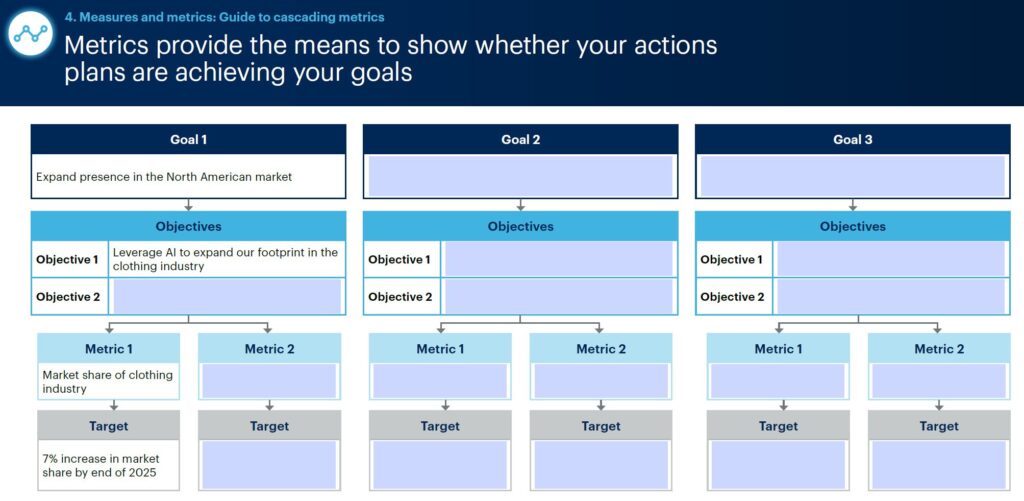
Often the bridge between strategic planning and operational marketing implementation is missing. What’s needed is planning across different time horizons, combined with a stewardship approach that enables agile adaptation of approaches to goal achievement.
An excellent means to close this gap, in my opinion, is OKRs (doesn’t have to be implemented extremely bureaucratically):
#3 Set Clear, Platform-Specific KPIs That Interest CEOs and CFOs
…so marketing budgets can be justified based on metrics like revenue contribution, market share in AI search, and brand presence along the buyer journey.
New KPIs in the context of chatbots and AI search engines:
- Share of Voice along the buyer journey (market shares)
- Revenue via AI traffic
- Website retrievals by AI bots (growing influence)
There’s a detailed episode on this topic where we dive deep into measurability and KPIs for chatbots and AI search engines:
MARKETING TRENDS FOR “BRAND POSITIONING & AI VISIBILITY”
#4 Sharpen Your Brand’s Digital Representation
…to ensure that generative AI recommends your brand in the right contexts and thus influences purchase decisions.
In the future, AI assistants will cover a large part of the customer journey and pre-qualify users to a certain extent. In doing so, they take over a large part of the research and curate information in tailored answers.
This means: brands lose control over their content to a certain degree. AI assistants consume arbitrary sources, determine the brand’s presentation, and ultimately decide who gets recommended at the end of the conversation.
Therefore, the digital footprint—everything that exists about the brand on the internet—must be cleaned up and managed so that language models get a clear, accurate picture.
Why? So that AI assistants mention our brand in the right conversations with ideal customers – and ultimately recommend it.
Today it’s more important than ever to know exactly for whom you’re the right solution, why – and how you clearly stand out from the market.
#5 Launch Targeted Digital PR Campaigns Along the Buyer Journey
…to be visible where AI systems derive their recommendations, and thus maximize your chances of inclusion in training data and answers.
The previous point was about cleaning up and managing positioning. This is about proactively establishing it.
One possible priority: appear regularly in top-tier media that language models use for their training data. The goal is not just to be cited in AI assistants, but to be considered as part of the underlying training data.
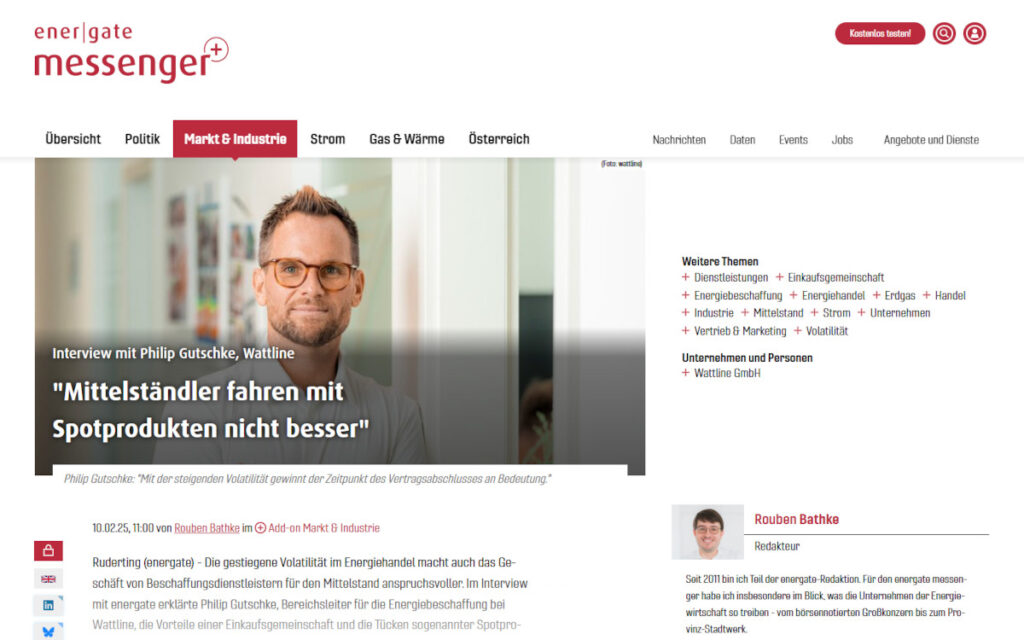
Depending on the business model, another priority could be to land as high as possible in best-of lists that are cited in AI search engines along the buyer journey.
Example: A large SaaS company whose performance in generative search environments strongly depends on being listed high in relevant comparison portals. The path there: first get on the lists, then collect reviews, and finally invest in paid promotion.
MARKETING TRENDS FOR “CUSTOMER JOURNEY REFRESH”
#6 Update and Prioritize Your Customer Journey Maps
…so marketing measures respond to changed research and buying processes before competitors occupy these touchpoints.
User behavior is currently changing fundamentally – not only through generative AI, but also through the different research behavior of new generations.
That’s exactly why customer journey maps should be updated and the most important journeys re-prioritized.
Guiding questions:
- How well are our current strategies aligned with our target audience’s needs, journeys, and behaviors?
- Which customer journeys are most important to us?
- Are we underutilizing our martech stack or are we missing contemporary solutions?
Example: A large B2B industrial company found that its target audience (primarily buyers) spends most research time in Microsoft Copilot. We’re currently seeing such patterns in many industries in parallel.
#7 Cover the Complete Buyer Journey on Your Website
…to ensure no relevant questions remain unanswered and AI systems use your content as the primary source.
Analogy: The internet is transforming from 2D to 3D.
Previously, keywords were the focus; today it’s about context-rich conversations in AI assistants that conduct extensive research for the user in the background.
This requires more volume than human teams can ever deliver and is only achievable with AI workflows.
#8 Invest in Demand Generation
…to actively create demand that long-term increases brand and product searches and thus additionally secures AI visibility.
Demand generation, whether via paid, PR, or influencer marketing, is no longer an option in 2026 but the ticket to even appearing in your target audience’s purchase decisions.
It not only fills the current pipeline but decides whether you’ll play a role in tomorrow’s AI-supported buyer journey.
MARKETING TRENDS FOR “ORGANIZATION & ENABLEMENT”
#9 Automate Repetitive Marketing Processes with AI
…to respond faster to market changes and scale content volume without sacrificing quality or brand message.
As Kevin Indig calls it: The new normal in marketing is ongoing disruptions.n.
Since budgets are lower than before COVID and marketing teams rarely grow, it’s not about more headcount but about using AI workflows and AI-Agents.
At the C-level, AI marketing often has a bad reputation, mainly due to sloppy use of ChatGPT. But ChatGPT isn’t suitable for everything.
Instead, what’s needed:
- Preparation of internal data for AI
- Clear guidelines
- Tailored workflows for appropriate internal processes
Example: For a large tech consulting company, we developed appropriate AI workflows for content along the buyer journey—from data collection to guideline definition to complete mapping of the editorial process.
#10 Break Down Silos and Promote Cross-Departmental Communication
…to share knowledge, insights, and resources between teams that together increase your brand presence and innovation speed.
The isolation of specialist departments is still widespread. One of the biggest levers: link SEO, content, PR, social, UX, brand, product, and IT more closely together. In many cases, regular communication between these areas alone would bring enormous effects.
In practice, work is often redundant or even in different directions.
Yet this applies:
Everything works together, everyone can learn from each other, and everyone can massively benefit from each other.
Your Next Steps
2026 will be a year of clear positioning. Those who invest in the right marketing trends now and set the right priorities will not only realize efficiency gains but conquer real market shares.
For this to succeed, you should immediately tackle three things:
Strategic Anchoring at C-Level
Ensure that management and financial officers understand the significance of AI for visibility, customer journey, and revenue contributions. Only this way can you secure budgets and get support for implementation.
Secure Visibility in the AI Era
Build your brand so it’s present in generative search and recommendation environments. This means: sharpen digital presence, launch targeted digital PR, and ensure AI systems recommend your brand in decisive moments.
Make Organization and Processes Fit
Break down silos, automate repetitive tasks, and establish AI workflows that combine speed and quality.
Your goal:
Free up resources for real growth initiatives.
If you consistently implement these steps, you’re not just prepared for AI disruption – you’re transforming it into a competitive advantage.




Comment